
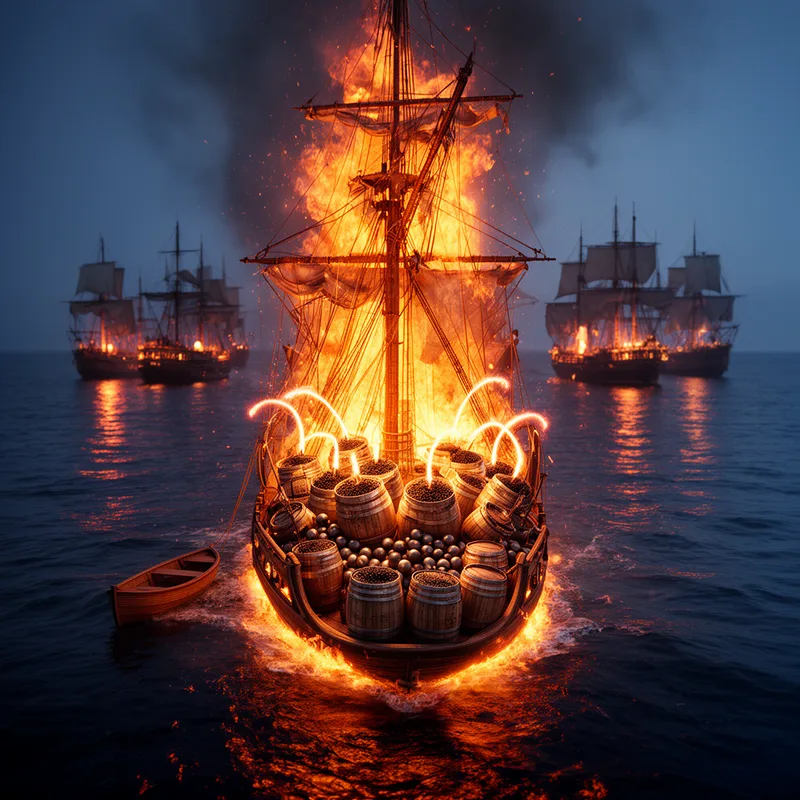
fire ship
- noun
- /ˈfaɪər ʃɪp/
- Archaic
- Fire ships!
Loading YouTube…
Watch on YouTubeSatisfied with this plan, Lord Mulgrave ordered Cochran to join Admiral Gambia's fleet at Basque Roads and personally lead the fire ships charge.
- Satisfied with this plan, Lord Mulgrave ordered Cochran to join Admiral Gambia's fleet at Basque Roads and personally lead the fire ships charge.
Examples
-
Six fire ships into the Spanish formation, that may force them to scatter.
-
A huge fleet destroyed by Vandal fire ships off Cape Bon.
-
These were the fire ships which would protect the city for centuries to come and change the course of history.
-
If the wind is with us, Walter, we can attack them with fire ships.
-
Fire ships!
-
A huge fleet destroyed by Vandal fire ships off Cape Bon.
-
England sends burning fire ships, which scorch and sink the Armada's galleons.
-
Satisfied with this plan, Lord Mulgrave ordered Cochran to join Admiral Gambia's fleet at Basque Roads and personally lead the fire ships charge.
-
The convoy was in fact a squadron of nine Spanish fire ships which erupted into flames as they drifted towards Vice Admiral Duff's vessels.
-
During the battle, they unleashed a fleet of fire ships to disrupt the enemy's formation.
Surface Forms
Morphology
The noun combines easily recognizable constituents: 'fire' and 'ship', so a B1 learner who knows both words would infer it refers to a ship associated with fire (e.g. burning or used with fire). However, the precise historical/military sense — a vessel deliberately filled with explosives and sent as a weapon — is a specialized, non-obvious extension beyond the literal compound, so the meaning is not fully predictable without exposure.
Etymology
The noun fire ship comes from real sea battles: sailors would set a ship on fire or fill it with explosives and send it straight toward enemy ships to burn or blow them up. So today fire ship means 'a ship used to burn or blow up enemy ships'.

