
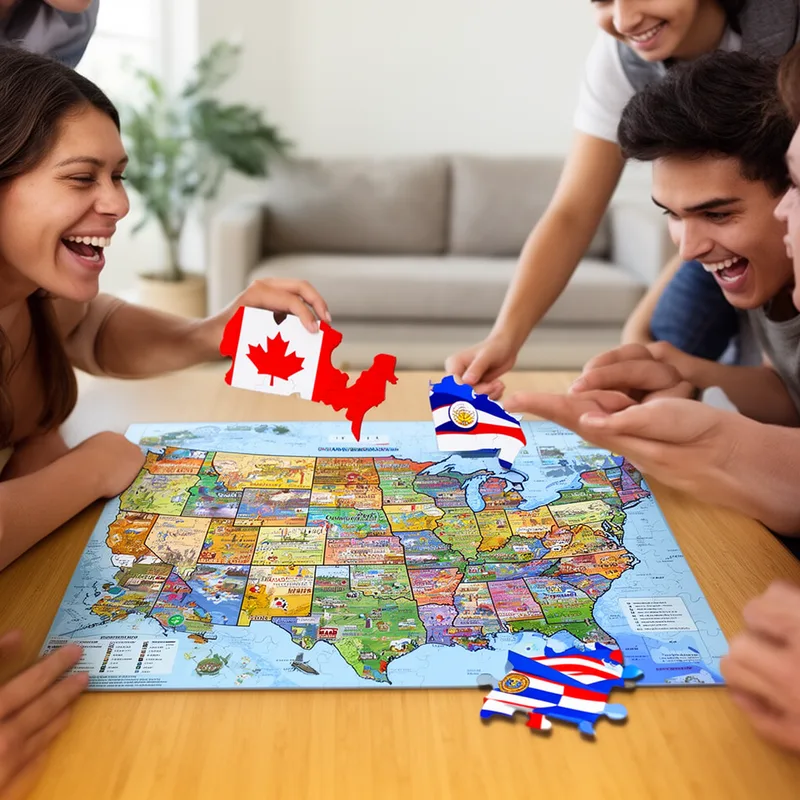
fifty-first state
- noun
- /ˈfɪfti fɜrst steɪt/
- Informal
- Politicians have debated whether Puerto Rico should become the fifty-first state in the US.
Examples
-
Many people jokingly refer to Puerto Rico as the fifty-first state.
-
Many Canadians joke about their country's close ties by calling it the fifty-first state.
-
At one time, some people referred to Hawaii as the fifty-first state before it officially joined the Union.
-
Alaska is sometimes seen as the fifty-first state due to its unique culture.
-
Many Canadians joke about their country's close ties by calling it the fifty-first state.
-
At one time, some people referred to Hawaii as the fifty-first state before it officially joined the Union.
-
Politicians have debated whether Puerto Rico should become the fifty-first state in the US.
Surface Forms
Morphology
fifty-first + state
The phrase is compositionally built from the ordinal 'fifty-first' and 'state', so a learner who knows both words can infer it means a hypothetical or next (51st) state. However, its typical colloquial/political use (humorously referring to a territory or foreign country seen as closely tied to the U.S.) requires cultural/pragmatic knowledge beyond simple word meanings, so it is not fully transparent.
Etymology
Fifty-first state comes from the simple image that the United States has 50 states, so a new place would be the 'fifty-first' one. People use this idea jokingly for a territory or country very close to the US, so it means 'very closely connected to the United States'.

