
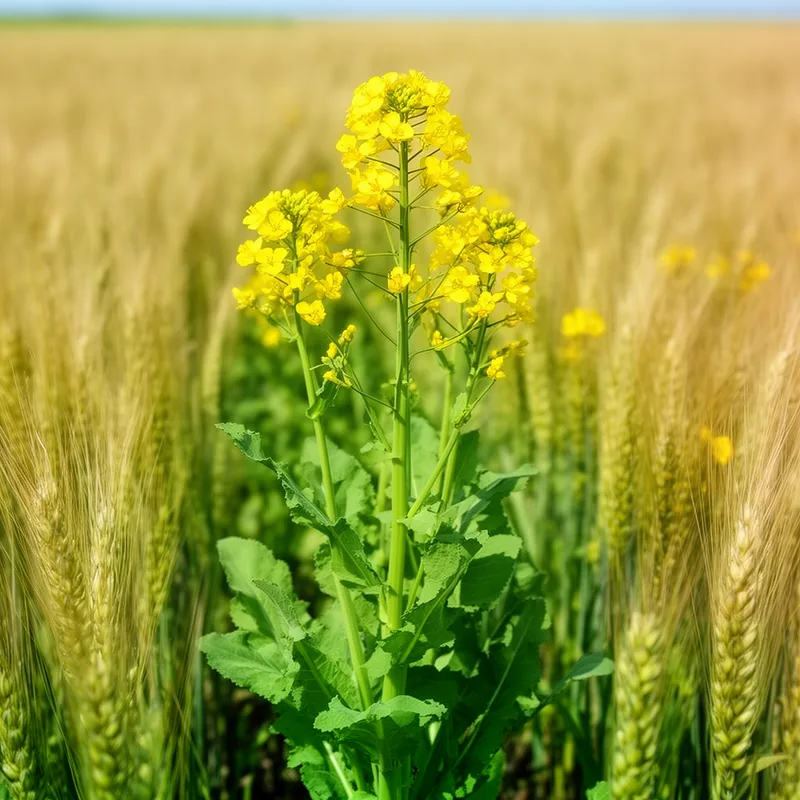
field mustard
- noun
- /fiːld ˈmʌstərd/
- She recognized field mustard by its bright yellow flowers scattered across the field.
Examples
-
The field mustard spread rapidly through the farmer's wheat crop, reducing its yield.
-
Farmers often consider field mustard a nuisance.
-
Researchers study field mustard to understand how weeds adapt to agricultural environments.
-
The field mustard is blooming in the spring.
-
Farmers often find field mustard growing in their crops, which can reduce overall harvest quality.
-
The bright yellow flowers of field mustard can be seen flourishing in many open fields during late spring.
-
Many gardeners prefer to remove field mustard from their plots, as it can quickly overtake other plants.
Synonyms


 1
4.2
1
4.2
A weed with bright yellow flowers that grows in farm fields

A common wild plant with yellow flowers that grows in grain fields and harms crops

A wild plant with yellow flowers that grows among crops and is often a weed
A wild mustard plant with bright yellow flowers that grows as a weed in grain fields

A weed that grows in grain fields and harms crops
Surface Forms
Morphology
The noun is a straightforward compound of 'field' + 'mustard' and denotes mustard that grows in or is associated with fields; a B1 learner who knows both words can readily infer this botanical meaning. Naming plants by habitat or form is a common compositional pattern across languages, so the sense is transparently derived from the constituents.
Etymology
Field mustard comes from the simple picture of a wild mustard plant growing in a field, with bright yellow flowers scattered across the land. That's why field mustard now means a common plant often seen as a 'weed' in fields.