
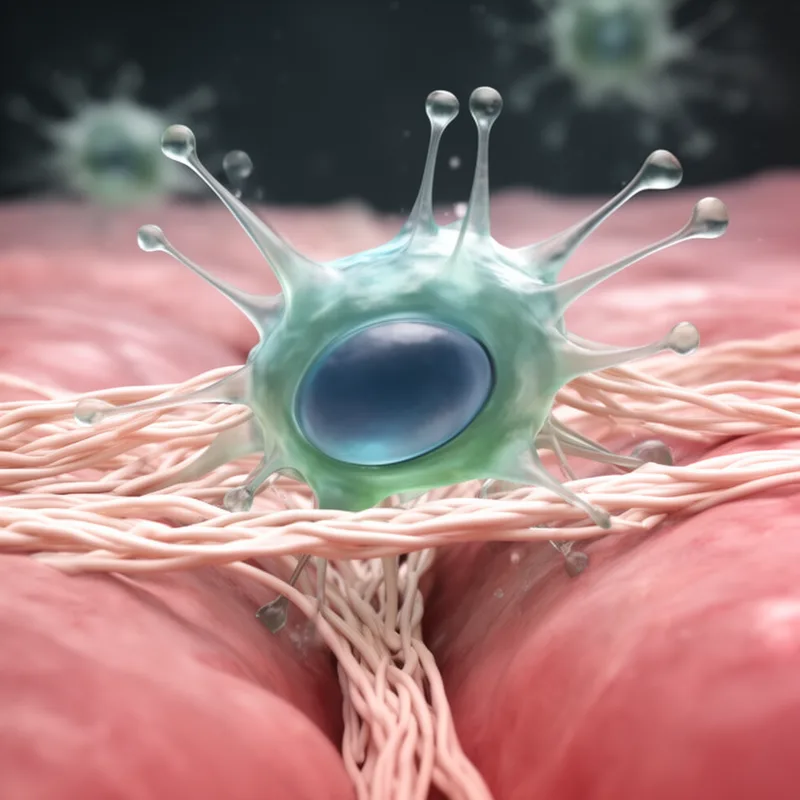
fibroblast
 4
8.4

- noun
- /ˈfaɪbroʊˌblæst/
- Specialized
- During wound healing, fibroblasts migrate to the injury site to produce new connective tissue.
- fibroblast cell
- fibroblast and collagen
- fibroblast growth
Loading YouTube…
Watch on YouTubeAnd then, you know, the fibroblasts in the fibroclasts, these little cells that either add tissue or take tissue away, they respond accordingly.
- And then, you know, the fibroblasts in the fibroclasts, these little cells that either add tissue or take tissue away, they respond accordingly.
Examples
-
In a normal nerve, most of the collagen is produced by the fibroblasts in the epineurium.
Academic text (2015) -
And these cells are initially cells that are called fibroblasts, which live in the dermis.
-
One of the important functions of a fibroblast is to is to allow for healing of wounds.
-
From patients with ALD, I took fibroblasts - skin cells, OK?
-
Cells within the dermis include fibroblasts, macrophages, mast cells, and leukocytes.
Academic text (1995) -
Regulation of TGF in vitro and inhibition of fibroblast and collagen synthesis have been shown in animal models of lung fibrosis.
Academic text (2016) -
Ligament repair involves a variety of factors such as BMP-7, TGF, and PDGF, and cells including fibroblasts and myoblasts.
Academic text (2018) -
Fibroblasts play a crucial role in tissue repair by producing collagen and other fibers.
-
In the dermis of the skin, fibroblasts are essential for maintaining the structural integrity.
Surface Forms
Morphology
fibroblast = fibro + blast (semi-transparent) = fibro + blast
The components 'fibro' and 'blast' are clear in a biological context, but the specific role of fibroblasts in connective tissue is specialized knowledge.
Etymology
The word fibroblast starts with fibro- meaning 'fiber' and ends with -blast meaning 'young cell' or 'sprout'. So, a fibroblast is a cell that makes the fibers that help hold tissue together and repair wounds.