
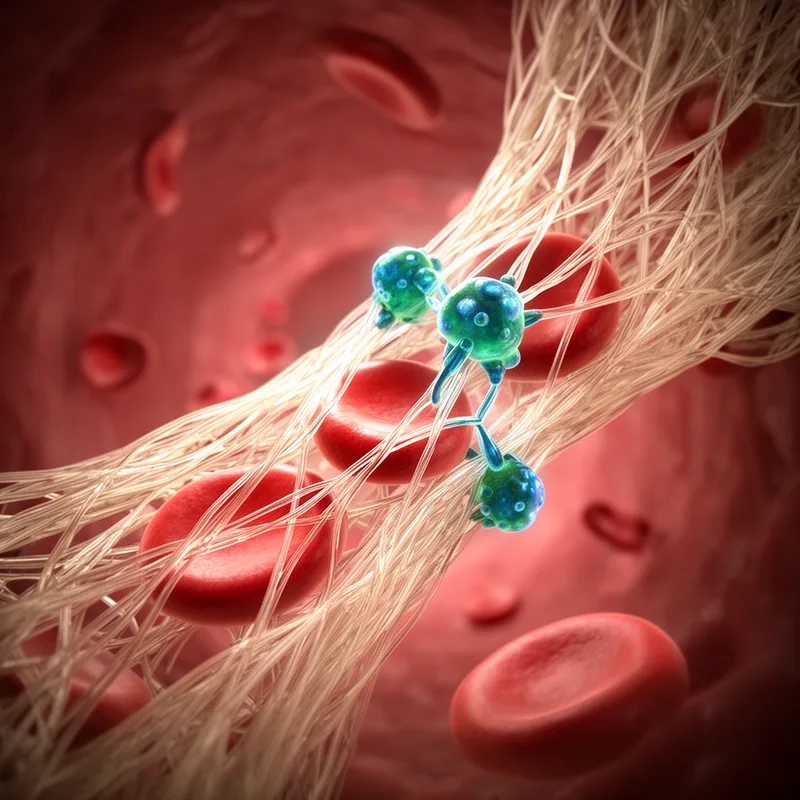
fibrinase
- noun
- /ˈfaɪbrɪneɪz/
- Specialized
- The activation of fibrinase is essential for forming stable blood clots.
Examples
-
Without sufficient fibrinase, clots may remain weak and easily dissolve.
-
Scientists have discovered that fibrinase stabilizes blood clots.
-
Researchers studied the function of fibrinase in patients with bleeding disorders.
-
The fibrinase plays a crucial role in blood clotting.
-
The activation of fibrinase is essential for forming stable blood clots.
-
Researchers studied the function of fibrinase in patients with bleeding disorders.
-
Without sufficient fibrinase, clots may remain weak and easily dissolve.
Synonyms

A blood protein that makes clots stronger so they do not break
Surface Forms
Morphology
Etymology
The word fibrinase comes from fibrin, the protein that makes 'fiber' threads in a blood clot, and the enzyme ending -ase which means 'enzyme'. So, fibrinase is an enzyme that works on fibrin to help make blood clots strong.

