
fibrin
 1
8.5
1
8.5

- noun
- /ˈfaɪbrɪn/
- Specialized
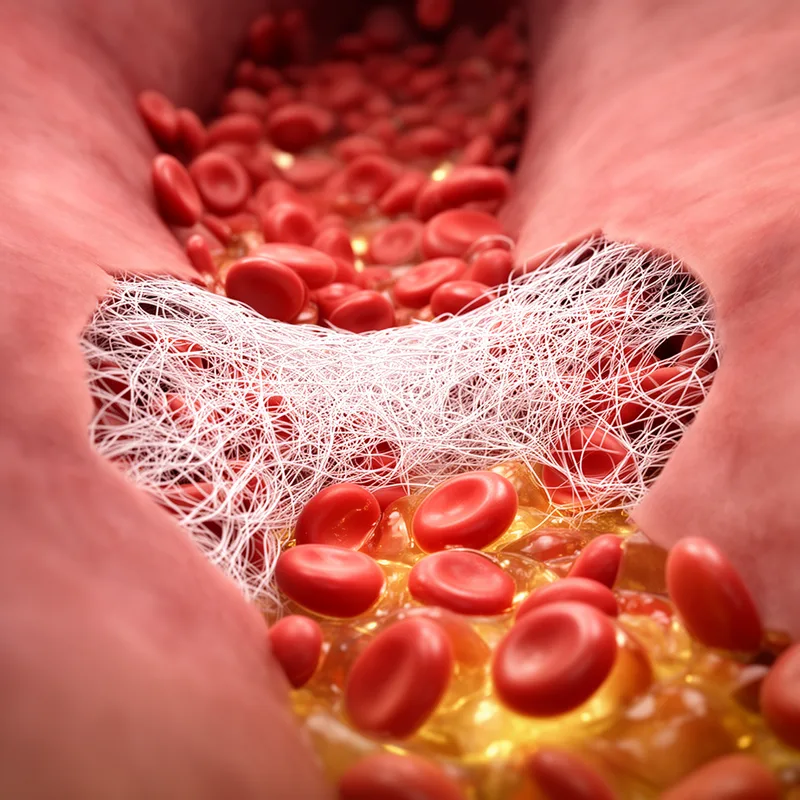
- During blood clotting, fibrin forms a mesh that helps to stop the bleeding.
- fibrin glue
- fibrin sealant
- fibrin clot
Examples
-
We conclude that fibrin sealants offer a comparative advantage over under-flap suction in both thyroid and parathyroid surgery.
Academic text (2006) -
The neurofilaments on the left are found in nerve cells; the fibrin filaments on the right are found in blood clots.
Academic text (2005) -
The bone dust was then fixed with fibrin glue.
Academic text (1998) -
Fibrin, on the other hand, can be stretched to several times its original length before breaking.
Academic text (2005) -
Commercially available fibrin glue is made up of two components:
Academic text (2006) -
The dust was gently compressed and fixed with fibrin glue.
Academic text (1998) -
That converts fibrinogen to fibrin and as a result, coagulation occurs.
-
So it's dissolved in the blood, turning into an insoluble fibrin matrix that all the platelets then stick to to make our solid clot.
-
Factor Ha (thrombin) turns fibrinogen into fibrin, and factor Xa turns prothrombin into thrombin.
Academic text (2015) -
Acute inflammatory cells migrate to the injured area, which is initiated by vascular dilatation and exudation of fibrin-rich plasma.
Academic text (2002)
Surface Forms
Morphology
fibrin = fibr + in
Formally analyzable as the combining form 'fibr-' + chemical noun-forming suffix '-in', but 'fibr-' is not a standalone modern English word and '-in' is a specialized scientific suffix, so the meaning is not fully obvious to an average B1 learner.
Etymology
The word fibrin comes from the root fibr- meaning 'fiber', the same idea you see in the English word fiber. That's why fibrin is a protein that makes a fine net of thread-like strands to trap blood and help a clot form.