
ferromagnetic
 1
9.3
1
9.3

- adjective
- /ˌfɛroʊˈmæɡnɪtɪk/
- Specialized
- One team, led by Stuart Parkin of the IBM Research Laboratory in Almaden, California, made a tunnel junction with polycrystalline MgO and ferromagnetic layers using sputtering techniques, which are amenable to mass production.
- ferromagnetic layer
- ferromagnetic material
Loading YouTube…
Watch on YouTubeI guess I can use non ferromagnetic?
- I guess I can use non ferromagnetic?
Examples
-
Internal, ferromagnetic, stainless steel tags were successfully used to tag both adult and juvenile menhaden.
Academic text (1991) -
Typically, the magnetic moment of one of the two ferromagnetic layers is fixed, and the other one is free to respond to the field of the bit being read.
Academic text (2004) -
" We try to look for simple ferromagnetic compounds whose costs are low," he said.
Academic text (1994) -
And well, if it looks like it, it is actually an effective ferromagnetic spin spin interaction.
-
His method helped researchers to see, through microscopy, ferromagnetic domain boundaries.
Academic text (2003) -
The tunneling current typically flows more readily when the ferromagnetic moments are aligned than when they are opposed.
Academic text (2004) -
MTJs also consist of two layers of ferromagnetic material, but they are separated by an insulating layer.
Academic text (2004) -
MTJs can also be used to store data bits, with the information coded by the magnetization direction of the free ferromagnetic layer.
Academic text (2004) -
More recently, ferromagnetic resonance studies have been applied to longitudinal thin films, suggesting the formation of Cr-rich nonmagnetic components.
Academic text (1996) -
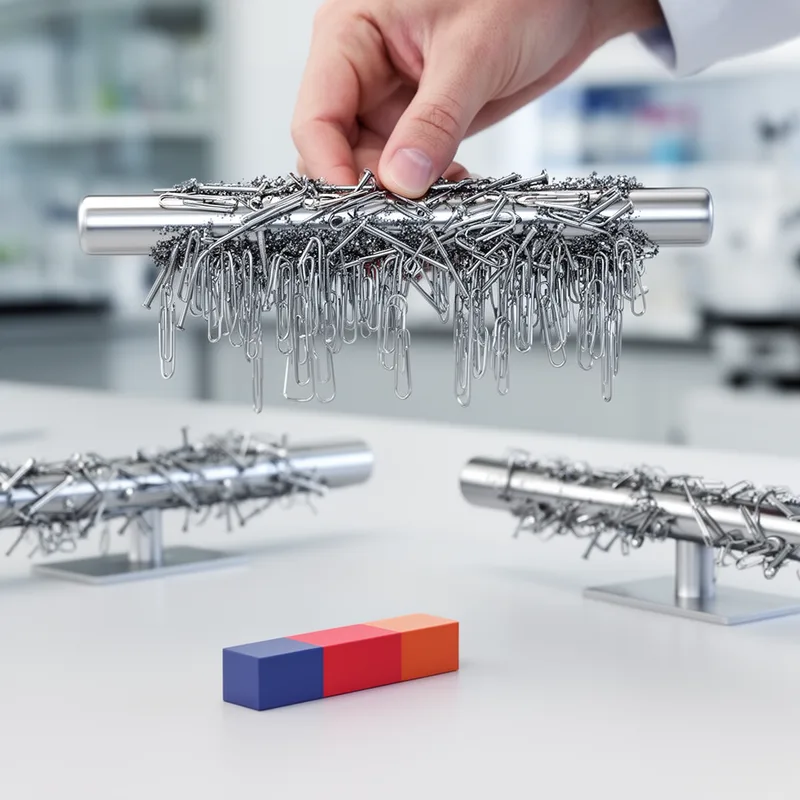
Iron is a common example of a ferromagnetic material, as it can be magnetized and hold that magnetization even after the external magnetic field is removed.
Synonyms
 161
3.5
161
3.5
Able to pull certain metals like iron
How Magnetic
- Specialized
1
9.3

- Specialized
- Specialized

 1
9.9
1
9.9
- Specialized
Surface Forms
Morphology
Etymology
Ferromagnetic is made of two parts: ferro-, which means 'iron', and magnet, the everyday word 'magnet'. So ferromagnetic describes materials like iron that easily become very magnetic and can keep their magnetism even after an outside magnet is taken away.