

fer-de-lance
- noun
- /ˌfɛr də ˈlɑːns/
- US
- After being bitten by a fer-de-lance, he was rushed to the hospital for immediate medical attention.
- fer-de-lance pit viper
- deadly fer-de-lance
Examples
-
Scorpions infest the orchards, and the yellow viper or fer-de-lance lives on the mountainside.
Fiction book (1991) -
I was told there was an increased likelihood of this because the fer-de-lance community had become enraged that a human had survived an attack while a brother viper had been killed.
Academic text (1996) -
There are cayman, fer-de-lance, and water moccasins.
Fiction book (1998) -
A fer-de-lance had bitten Efran on the toe, and the entire lower leg had swollen by the time I got to him.
Academic text (1996) -
The question of "to do or not to do?" was again answered when, in August 1990, I watched Victor, a seven-year-old, laughing and walking two weeks after being severely bitten by a fer-de-lance.
Academic text (1996) -
In spite of the traumas suffered by his wife and son during Felix's brief terminal illness in Vozandes, they came immediately to the same hospital for foundation support when the fer-de-lance struck.
Academic text (1996) -
While hiking in the rainforest, I was warned to stay clear of the fer-de-lance, a snake known for its aggressive nature.
-
A local guide explained that the fer-de-lance is one of the most dangerous snakes in Central America due to its potent venom.
Synonyms

 3
8.0
3
8.0

A snake with a heat pit near each eye that injects poison when it bites

A large venomous snake found in Central and South America
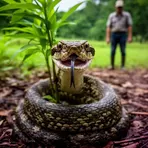
A venomous snake from Central and South America, often called fer-de-lance
Surface Forms
Etymology
Fer-de-lance comes from French parts fer ('iron') and lance ('spear'), so it literally means 'iron of the spear' because the snake's head looks like a spear tip. That's why the name helps you remember it is a large, very venomous snake with a spear-shaped head.