

family Otididae
- noun
- /ˈfæmɪli oʊˈtɪdaɪ/
- Specialized
- The family Otididae is known for its large, ground-dwelling birds called bustards.
Examples
-
Did you know that the family Otididae is primarily found in open grasslands?
-
The family Otididae includes some of the heaviest flying birds in the world.
-
Conservation efforts for the family Otididae focus on habitat protection and anti-poaching measures.
-
Many species in the family Otididae are threatened due to agricultural expansion.
-
The family Otididae includes several species of bustards.
-
Birdwatchers often seek to observe members of the family Otididae in their natural habitats.
-
In the family Otididae, males perform elaborate courtship displays to attract females.
Synonyms
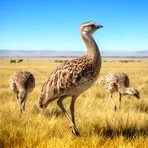
Large ground birds like bustards that live in open grasslands in Africa and Eurasia
Surface Forms
Morphology
The phrase is directly compositional: 'family' denotes a taxonomic grouping and 'Otididae' is the scientific name of that family, so the combined meaning (the family called Otididae) is immediately derivable from the parts. This noun+name pattern is a standard, cross-linguistic scientific naming convention, so a B1 learner who knows both constituents would understand it.
Etymology
Family Otididae comes from the old Greek word 'otis', a name for large ground birds called 'bustards'. The parts family and Otididae were used by scientists to name the group of heavy birds that live on the ground, so today family Otididae refers to that group.

