
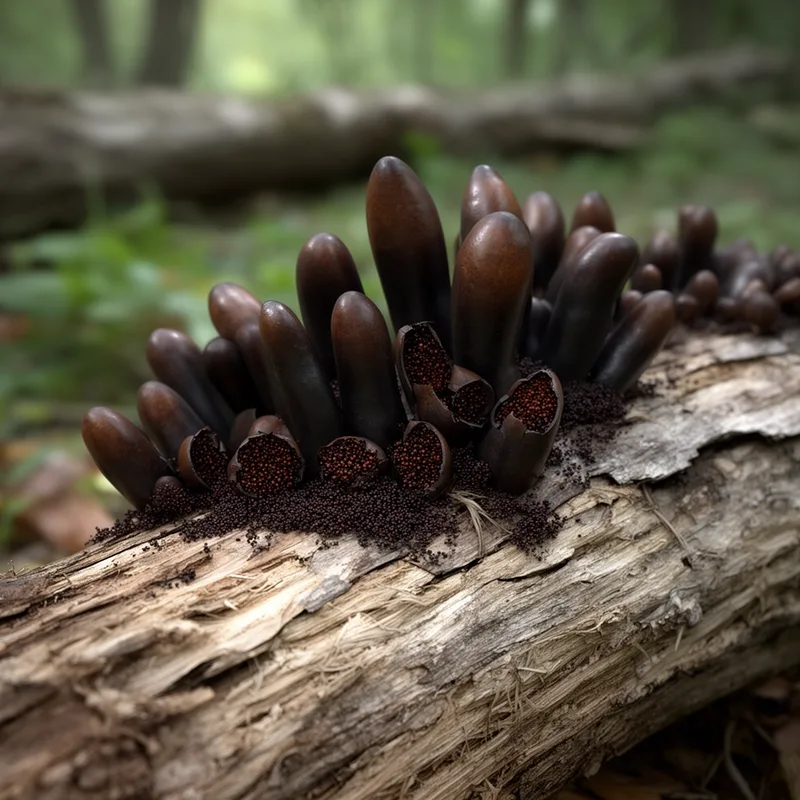
family Xylariaceae
- noun
- /ˈfæmɪli zaɪˈlɛəriˌeɪsi/
- Specialized
- Members of the family Xylariaceae are commonly found on decaying wood in forests.
Examples
-
Many members of the family Xylariaceae are recognized for their dark brown to black spores, which aid in their identification.
-
The scientist identified the fungus as belonging to the family Xylariaceae based on spore characteristics.
-
Several economically important species are classified within the family Xylariaceae.
-
The family Xylariaceae includes many wood-decaying fungi.
-
Did you know that the family Xylariaceae has dark spores?
-
The family Xylariaceae consists of fungi that play a vital role in breaking down decaying wood in forest ecosystems.
-
Researchers have discovered that the family Xylariaceae contains several species that are essential for the decomposition process in forests.
Synonyms
A group of fungi that live on dead wood and have dark spores
Surface Forms
Morphology
family + Xylariaceae
The phrase combines the noun 'family' (a scientific grouping) with a taxonomic name, so its meaning — 'the family named Xylariaceae' or 'the family of organisms called Xylariaceae' — is directly compositional. Although the Latin name itself conveys no everyday meaning, the structure is predictable and non‑idiomatic, so a learner who recognizes taxonomic labeling can infer the intended meaning.
Etymology
Family Xylariaceae comes from the Greek root xyl- meaning 'wood' and the scientific ending -aceae meaning 'family'. These fungi often grow on and break down wood, so the name helps you remember they are a 'family' of wood fungi.

