
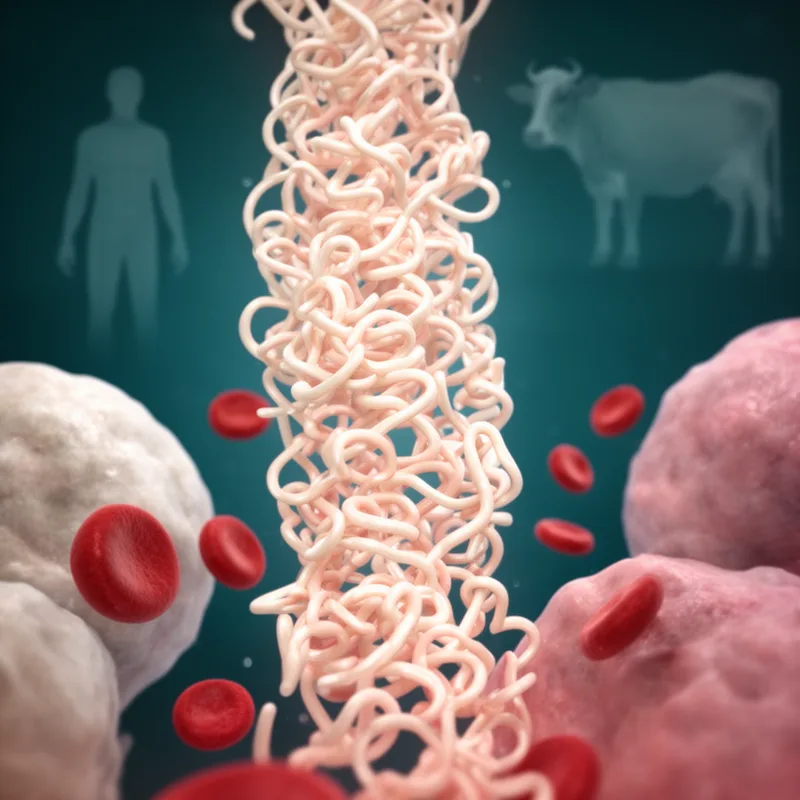
family Treponemataceae
- noun
- Specialized
- The family Treponemataceae includes the agent responsible for syphilis.
Examples
-
The family Treponemataceae includes various species of spirochetes.
-
Some bacteria in the family Treponemataceae are known to cause serious human diseases.
-
Researchers studied the role of the family Treponemataceae in animal infections.
-
Some members of the family Treponemataceae are pathogenic.
-
The family Treponemataceae includes various species of spirochetes that can infect both humans and animals.
-
Some bacteria in the family Treponemataceae are known to cause serious human diseases like syphilis and yaws.
-
Researchers studied the role of the family Treponemataceae in the spread of infections amongst livestock.
Synonyms

A group of small bacteria that sometimes cause disease in people and animals
Surface Forms
Morphology
family + Treponemataceae
This is a straightforward taxonomic NP: 'family' denotes a scientific grouping and combining it with a taxon name (Treponemataceae) transparently yields the biological family named Treponemataceae (a group of spirochete bacteria). The meaning is compositional and follows a common cross-linguistic pattern for naming taxonomic groups, so a learner who knows both constituents can infer the MWE meaning.
Etymology
Family Treponemataceae comes from Greek words trepo, meaning 'turn', and nema, meaning 'thread'. These bacteria look like tiny, twisted threads, and the word 'family' shows they are a group of related species, so the name fits a group of small, spiral bacteria, some of which can cause disease.

