

family Stizidae
- noun
- Specialized
- Members of the family Stizidae are known for their ability to paralyze cicadas to feed their larvae.
Examples
-
The family Stizidae includes several species that are commonly referred to as cicada killers.
-
Researchers observed nesting behaviors unique to the family Stizidae during the summer field study.
-
The family Stizidae includes many species of wasps.
-
Many insects belong to the family Stizidae.
-
The family Stizidae is known for its impressive hunting skills, particularly their technique for capturing cicadas.
-
Various species within the family Stizidae play a crucial role in controlling cicada populations by targeting them as prey.
-
Researchers have documented the unique life cycle of the family Stizidae, highlighting their solitary behavior and cicada hunting methods.
Synonyms
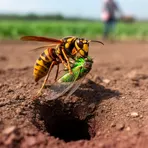
Large wasps that live alone and catch cicadas to feed their young
Surface Forms
Morphology
This is a straightforward compositional taxonomic label: 'family' (a scientific grouping) combined with the taxon name 'Stizidae' yields the family named Stizidae. There is no idiomatic or metaphorical meaning here and taxonomic naming conventions are cross-linguistically regular, so a learner who knows both constituents will understand the phrase.
Etymology
Family Stizidae is a scientific name given to a group of large, solitary wasps. These wasps catch and paralyze cicadas to feed their young, so the name points to the 'cicada killers' and their hunting habit.

