
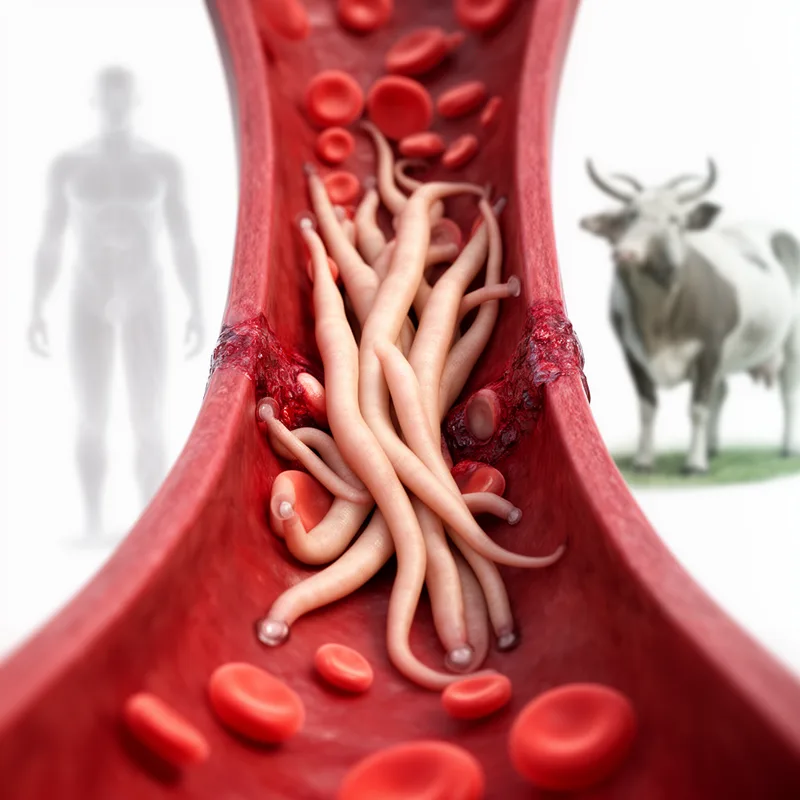
family Schistosomatidae
- noun
- /ˈfæmɪli ˌʃɪstəˈsoʊməˌtiːdeɪ/
- Specialized
- Many species in the family Schistosomatidae are known to cause schistosomiasis in humans.
Examples
-
Parasitologists often study the life cycles of worms in the family Schistosomatidae.
-
The family Schistosomatidae includes several species that are harmful to humans.
-
Research on the family Schistosomatidae has led to better treatments for parasitic infections.
-
Many researchers study the family Schistosomatidae for insights into parasitic diseases.
-
Many species in the family Schistosomatidae are known to cause schistosomiasis in humans.
-
The family Schistosomatidae includes several well-known parasites that affect livestock.
-
Researchers investigate the family Schistosomatidae to understand the impact of parasites on health.
Synonyms
A family of flatworms that live as parasites and cause a disease called schistosomiasis in people and animals
Surface Forms
Morphology
This is a straightforward compositional noun phrase: 'family' (a scientific grouping) combined with the taxonomic name 'Schistosomatidae' yields the meaning 'the taxonomic family called Schistosomatidae that contains those parasitic flatworms.' Taxonomic naming patterns are cross-linguistically regular, so a B1 learner who knows both constituents can readily infer the MWE's meaning.
Etymology
Family Schistosomatidae comes from the worm name Schistosoma, made of schisto- and -soma, which mean 'split' and 'body' because the male has a long groove that looks like a split where the female sits. So, family Schistosomatidae refers to this group of paired parasitic worms, some of which cause disease in humans.

