
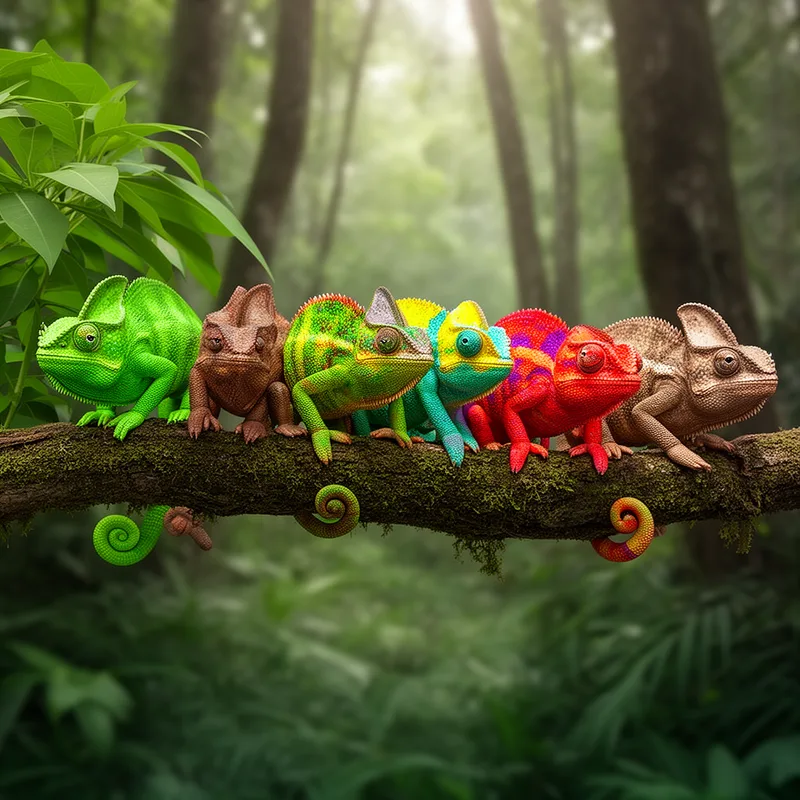
family Rhiptoglossa
- noun
- Specialized
- The family Rhiptoglossa primarily inhabits forests and woodlands in Africa and parts of Asia.
Examples
-
Many species within the family Rhiptoglossa display remarkable abilities to change color.
-
Research on the family Rhiptoglossa has contributed to our understanding of chameleon evolution.
-
The family Rhiptoglossa includes various species of chameleons.
-
Did you know that the family Rhiptoglossa is found in Africa?
-
The family Rhiptoglossa is known for its unique adaptations and distinct species of chameleons.
-
Many species within the family Rhiptoglossa are located in the tropical forests of the Old World.
-
Scientists have recently discovered new species in the family Rhiptoglossa that exhibit fascinating behaviors.
Synonyms


 1
9.9
A family of lizards that can change color and move each eye separately
A group of lizards that includes chameleons from Africa and Madagascar
A family of lizards that includes chameleons found in Africa, Europe, and Asia
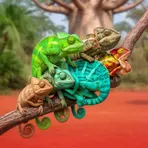
A group of lizards that includes chameleons which often change color and live in Africa and Madagascar
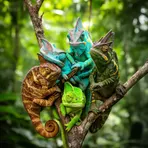
A group of chameleons, lizards that change colour, from Africa and Asia
Surface Forms
Morphology
The phrase combines the taxonomic noun 'family' (a scientific grouping) with the proper name 'Rhiptoglossa' denoting a specific group of chameleons, so the overall meaning ('the family named Rhiptoglossa, a group of chameleons') is directly compositional. Taxonomic constructions of the form 'family X' are cross-linguistically common and follow transparent naming patterns, so a B1 learner who knows both constituents would be able to infer the MWE's meaning.
Etymology
Family Rhiptoglossa probably comes from Greek parts like rhipto- and glossa, and glossa means 'tongue', so the name likely points to these chameleons' long, fast tongue used to catch insects.