
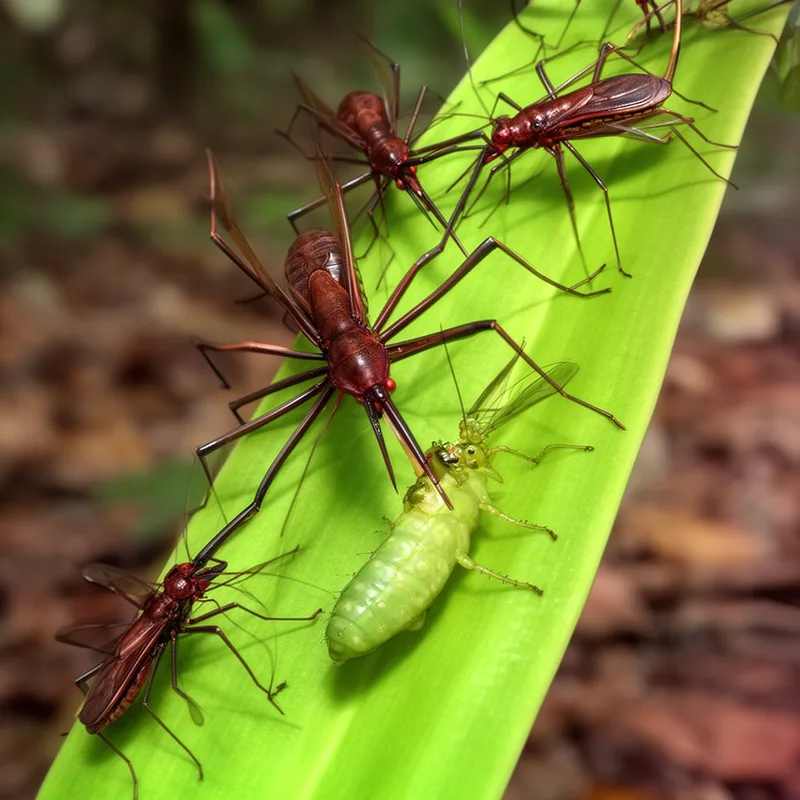
family Reduviidae


 1
9.9
- noun
- /ˈfæmɪli rɪˈduːviˌaɪ/
- Specialized
- The family Reduviidae includes many species commonly referred to as assassin bugs.
Examples
-
Researchers studying the family Reduviidae are interested in their predatory behaviors and roles in ecosystems.
-
Some members of the family Reduviidae are known to transmit Chagas disease in Central and South America.
-
The family Reduviidae includes many fascinating species.
-
Some insects from the family Reduviidae are known for their venomous bites.
-
Researchers studying the family Reduviidae focus on their predatory behaviors and ecological roles.
-
The family Reduviidae is notable for including species that are commonly called assassin bugs.
-
Some species in the family Reduviidae can be found in diverse habitats across Central and South America.
Synonyms
 1
8.8
A long-legged bug that eats other insects and sometimes sucks blood from mammals
 1
9.9
A group of bugs that hunt other insects using a long curved beak
Surface Forms
Morphology
The phrase is a straightforward taxonomic composition: 'family' (a scientific grouping) combined with the taxon name 'Reduviidae' yields the meaning 'the family called Reduviidae' or 'a family of assassin bugs.' This follows standard scientific naming patterns found across languages, so a B1 learner who knows both constituents can readily infer the MWE's meaning.
Etymology
Family Reduviidae is the scientific name for the group called 'assassin bugs'. These insects hunt quietly and use a long, sharp beak to pierce their prey and feed, so imagining a tiny 'assassin' stabbing its food helps you remember they are predatory insects.