

family Haliotidae
- noun
- Specialized
- The family Haliotidae includes several species prized for their decorative shells and edible flesh.
Examples
-
Many conservation efforts now focus on protecting members of the family Haliotidae from overfishing and environmental threats.
-
The family Haliotidae is known for its distinctive, ear-shaped shells that are often found in tide pools.
-
Scientists are studying the distribution of family Haliotidae in coastal waters worldwide.
-
The family Haliotidae includes various species of abalones.
-
Did you know that the family Haliotidae is known for its unique shells?
-
Many conservation efforts now focus on protecting members of the family Haliotidae, which are vital to marine ecosystems.
-
In culinary dishes, members of the family Haliotidae are often valued for their tender and flavorful meat.
Synonyms

 6
8.1

A large sea snail with a flat ear-shaped shell and a shiny inside that people eat


 1
7.9
A large sea snail with a flat, shiny shell eaten as food
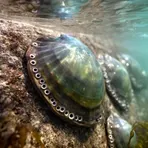
Sea snails with ear-shaped shells and a row of breathing holes
Surface Forms
Morphology
The phrase is a literal taxonomic noun phrase: 'family' (a grouping) combined with 'Haliotidae' (the gastropod group), so the meaning — the taxonomic family comprising abalones — follows directly from its parts. This compositional, cross-linguistically common pattern in biological nomenclature makes it immediately understandable to a learner who knows both constituents.
Etymology
The name family Haliotidae comes from an old Greek word that combines 'sea' and 'ear' because the shells of abalones in this family look like small ears, so the name now means the group of ear-shaped sea snails called 'abalones'.