
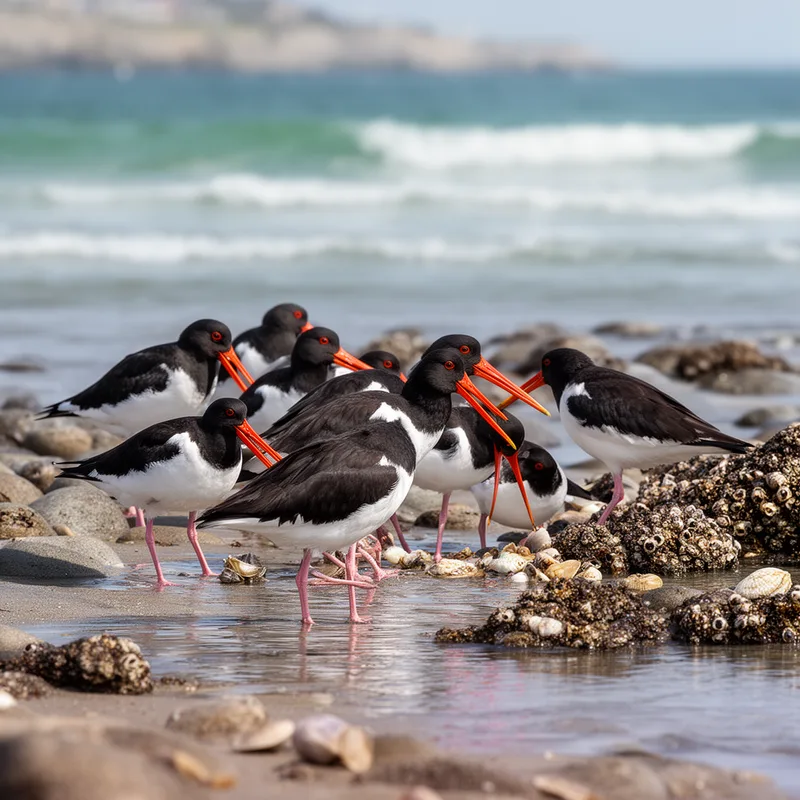
family Haematopodidae
- noun
- /ˈhæɪmətəˌpɒdɪdi/
- Specialized
- The family Haematopodidae comprises several species of oystercatchers found on seashores around the world.
Examples
-
Many birds from the family Haematopodidae have striking black and white plumage.
-
Birdwatchers were excited to spot a rare member of the family Haematopodidae during their coastal walk.
-
Extensive research on the family Haematopodidae has revealed fascinating behaviors related to feeding and nesting.
-
The family Haematopodidae includes various species of oystercatchers.
-
Birdwatchers were excited to spot a rare member of the family Haematopodidae during their coastal walk.
-
Extensive research on the family Haematopodidae has revealed fascinating behaviors related to feeding and nesting.
-
The family Haematopodidae comprises several species of oystercatchers found on seashores around the world.
Synonyms
A group of sea birds with strong beaks that open shellfish
Surface Forms
Morphology
family + Haematopodidae
The phrase is a straightforward taxonomic labeling: 'family' (a scientific grouping) combined with the proper name 'Haematopodidae' yields 'the family called Haematopodidae'. This compositional pattern (family + taxon name) is cross-linguistically common, so if a learner recognises the Latin name as a taxon, the overall meaning is immediately derivable.
Etymology
Family Haematopodidae comes from old Greek words haima and pous, meaning 'blood' and 'foot', because these oystercatcher birds have bright red legs. So the name refers to the 'group of birds' with red feet.

