

family Embiotocidae
- noun
- /ˈfæmɪli ɛmˈbaɪtəˌsaɪdi/
- Specialized
 :
familia Embiotocidae
:
familia Embiotocidae
- The family Embiotocidae consists of surf fishes commonly found along the Pacific coastline.
Examples
-
Members of the family Embiotocidae are known for giving birth to live young rather than laying eggs.
-
Researchers studied the reproductive strategies of the family Embiotocidae in California waters.
-
The family Embiotocidae includes various species of surf fishes.
-
Did you know that the family Embiotocidae is found along the Pacific coasts?
-
The family Embiotocidae includes several species that thrive in the coastal waters of the Pacific Ocean.
-
Fishermen often target members of the family Embiotocidae for their unique adaptability to their marine environment.
-
The family Embiotocidae is noteworthy for its viviparous reproduction, unlike many other fish families.
Synonyms
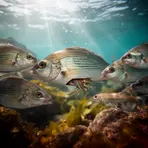
A group of fish that give birth to live young and live along Pacific coasts of North America and Asia
Surface Forms
Morphology
The noun phrase is fully compositional: 'family' denotes a taxonomic grouping and 'Embiotocidae' is the scientific name of that group, so a learner who knows both constituents can infer it refers to the taxonomic family of those fishes. This follows standard cross-linguistic scientific naming conventions rather than idiomatic usage, so the meaning is immediately derivable from the parts.
Etymology
Family Embiotocidae may come from old Greek words meaning 'living birth' because these surf fishes give 'live young' instead of laying eggs. So the name helps remind us that this group of fishes has babies that are born alive.

