
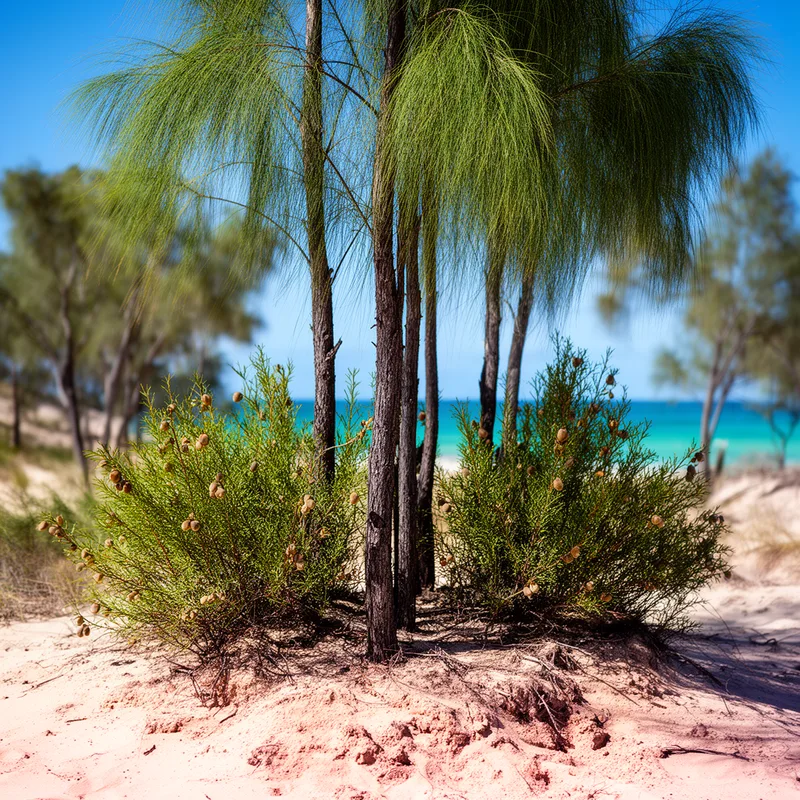
family Casuarinaceae
- noun
- /ˈfæmɪli ˌkæzjʊəˈrɪneɪsiː/
- Specialized
- The trees belonging to the family Casuarinaceae are often planted to stabilize sandy soils.
Examples
-
Species in the family Casuarinaceae are commonly found in Australia and Southeast Asia.
-
The family Casuarinaceae includes several species of trees.
-
The unique appearance of the family Casuarinaceae makes them easily recognizable among other plant families.
-
Many plants from the family Casuarinaceae thrive in sandy soils.
-
Species in the family Casuarinaceae are commonly found in Australia and Southeast Asia.
-
The trees belonging to the family Casuarinaceae are often planted to stabilize sandy soils.
-
Many plants from the family Casuarinaceae thrive in sandy soils.
Synonyms
A family of trees and shrubs like she-oaks that grow in Australia and nearby islands
Surface Forms
Morphology
family + Casuarinaceae
This is a straightforward compositional noun phrase: 'family' (a scientific grouping) combined with a taxonomic name yields 'the taxonomic family called Casuarinaceae.' Although 'Casuarinaceae' is a specialised proper name, the construction follows regular, cross-linguistic naming conventions, so a learner who knows the constituents can infer the meaning.
Etymology
Family Casuarinaceae gets its name from the genus Casuarina, which a plant scientist named after the 'cassowary' bird because the trees' thin, drooping branchlets looked like the bird's feathers. So the name points to this group of trees and shrubs with fine, feather-like branches.

