
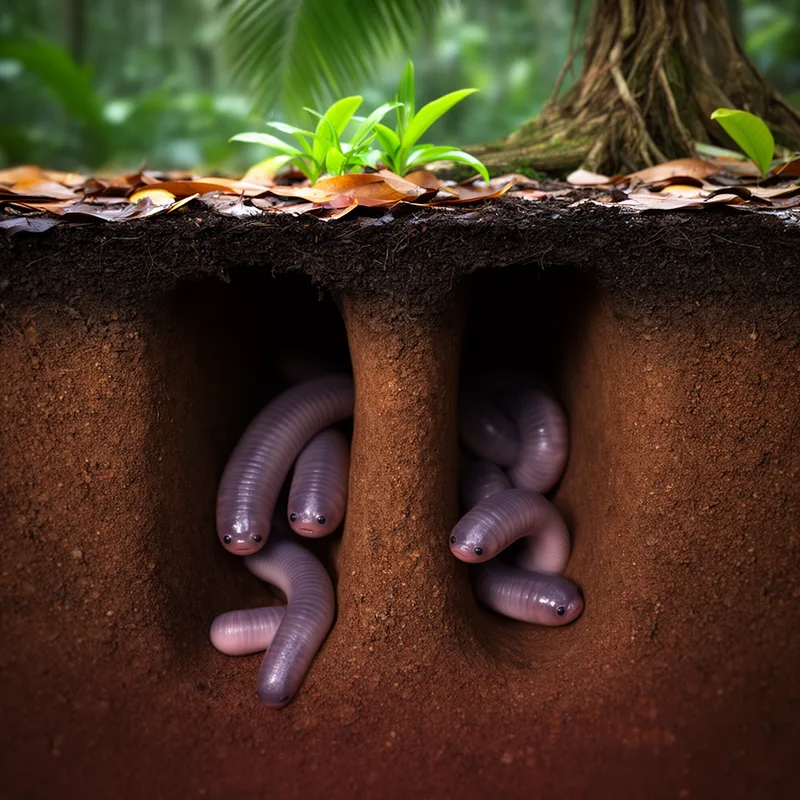
family Caeciliadae
- noun
- /ˈfæmɪli ˌsiːsɪˈleɪdi/
- Specialized
- The family Caeciliadae includes worm-like amphibians that are found in tropical regions.
Examples
-
Many members of the family Caeciliadae live underground and are rarely seen by humans.
-
Biologists have studied the reproduction patterns of species within the family Caeciliadae.
-
The family Caeciliadae includes various species of caecilians.
-
Did you know that the family Caeciliadae has unique adaptations?
-
Many members of the family Caeciliadae live underground and are rarely seen by humans.
-
The family Caeciliadae includes worm-like amphibians that are found in tropical regions.
-
Biologists have studied the reproduction patterns of species within the family Caeciliadae.
Synonyms

A group of limbless amphibians that look like worms and live underground in warm places
A family of legless amphibians with long bodies that live underground
A family of small legless amphibians that look like worms and live underground
Surface Forms
Morphology
family + Caeciliadae
The phrase is compositional: 'family' denotes a taxonomic grouping and 'Caeciliadae' is a taxon name, so the meaning is simply 'the family called Caeciliadae' (a group of organisms). Although 'Caeciliadae' is a technical Latin name and not decomposable into everyday English morphemes, a learner who knows both constituents would readily infer it refers to a biological family, so the expression is transparently interpretable.
Etymology
The name family Caeciliadae comes from the old name Caecilia, which comes from Latin for 'blind' because these animals have tiny eyes and often live underground. So today family Caeciliadae refers to the group of legless, worm-like amphibians.

