
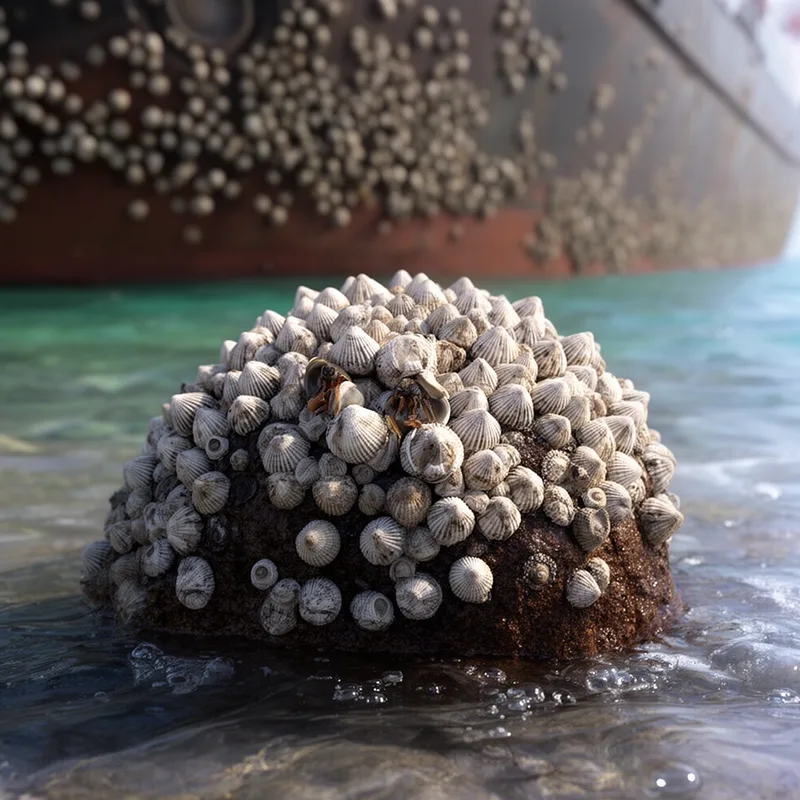
family Balanidae


 1
9.9
- noun
- Specialized
- The hard shells of barnacles in the family Balanidae protect them from predators and harsh conditions.
Examples
-
In tidal pools, members of the family Balanidae can be found firmly affixed to submerged rocks.
-
Scientists discovered several new species within the family Balanidae along the coastal reefs.
-
Many marine biologists study the family Balanidae to understand sessile crustacean evolution.
-
The family Balanidae consists of various species of barnacles.
-
I found a family Balanidae attached to the rock.
-
Marine researchers often observe the family Balanidae to learn about their unique adaptations to marine life.
-
The family Balanidae includes barnacles that play an important role in their ecosystems by filtering water.
Synonyms
 1
9.9
A group of barnacles without stalks and with cone-shaped shells that attach to rocks and ship hulls
Surface Forms
Morphology
The phrase is compositional: 'family' names a taxonomic grouping and 'Balanidae' is the specific taxon, so together they mean the taxonomic family called Balanidae (a group of barnacles). This follows standard scientific naming patterns found across languages, so a B1 learner who knows both constituents will readily understand the meaning.
Etymology
Family Balanidae may come from an old Greek word balanos meaning 'acorn', because these barnacles look like tiny acorns stuck to rocks. That's why the name now refers to a group of barnacles without a stalk that attach to rocks and other hard surfaces.