
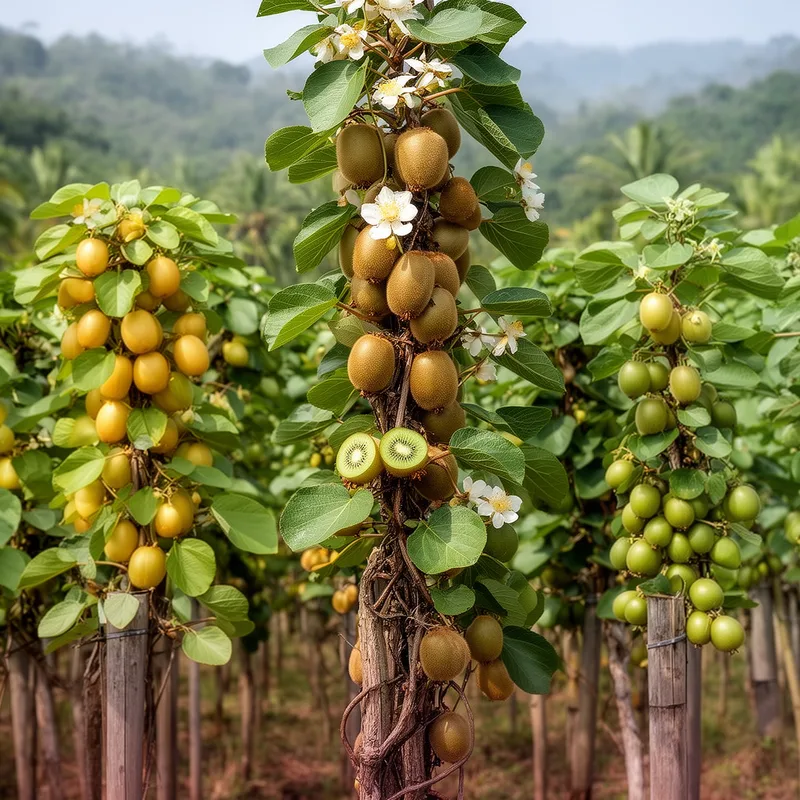
family Actinidiaceae
- noun
- /ˈfæmɪli ˌæktɪnɪˈdiːeɪsiː/
- Specialized
- The family Actinidiaceae includes economically important fruiting plants such as the kiwifruit.
Examples
-
Members of the family Actinidiaceae are commonly found in Southeast Asia and other subtropical regions.
-
The family Actinidiaceae includes many species of fruit-bearing plants.
-
Botanists have classified several tropical vines within the family Actinidiaceae.
-
Did you know that family Actinidiaceae contains the kiwifruit?
-
The family Actinidiaceae comprises various tropical trees and vines, known for producing the delicious kiwifruit.
-
Many plants belonging to the family Actinidiaceae thrive in humid environments, particularly in Southeast Asia.
-
Researchers are studying the family Actinidiaceae to enhance the cultivation of kiwifruit and related plant species.
Synonyms

A group of tropical trees, shrubs, and vines that includes the kiwifruit and grows mainly in East Asia
Surface Forms
Morphology
The phrase is directly compositional: 'family' denotes a taxonomic grouping and 'Actinidiaceae' is the name of that group (kiwifruit and related plants), so the full meaning follows immediately from the constituents. Taxonomic naming conventions are cross-linguistically regular, so a B1 learner who knows both constituents will understand this refers to a biological family of plants.
Etymology
Family Actinidiaceae is named after the plant group Actinidia, best known for the 'kiwifruit', and family means a group of related plants. The word Actinidia may come from a Greek word for 'ray' or 'star' because its flowers or hairs look like rays, so the name helps you remember that this family includes the kiwifruit and similar plants.

