
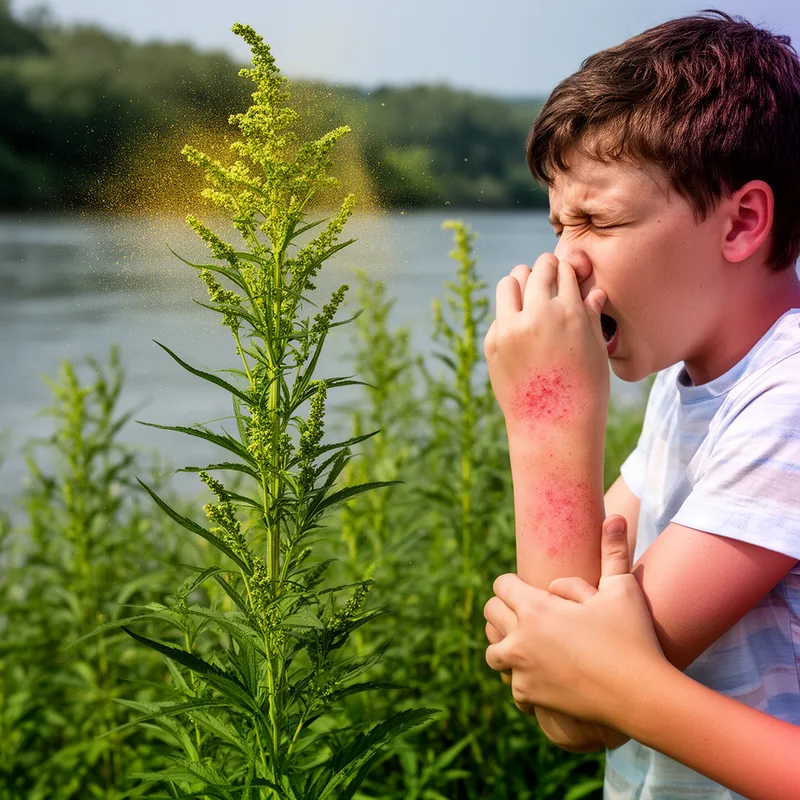
false ragweed
- noun
- /fɔls ˈræɡˌwid/
- US
- The false ragweed can trigger severe allergy symptoms during late summer in many parts of North America.
Examples
-
Many people develop itchy rashes after touching false ragweed in the fields.
-
The false ragweed thrives in damp, rich soils and is often found along riverbanks.
-
The false ragweed grows near the riverbank.
-
Many people are allergic to false ragweed pollen.
-
The false ragweed can trigger severe allergy symptoms during late summer in many parts of North America.
-
Many people develop itchy rashes after touching false ragweed in the fields.
-
Many people are allergic to false ragweed pollen.
Synonyms

A tall annual plant that grows in wet rich soil and causes skin and pollen allergies

A tall annual plant called marsh elder that often causes hay fever and skin rashes
Surface Forms
Morphology
The compound combines the adjective 'false' (not genuine / imitation) with 'ragweed' (a known allergenic plant), so a learner who knows both words can infer it denotes a plant that resembles or is mistaken for ragweed but is not the true ragweed. The 'false + noun' pattern to indicate a look‑alike or imitation is common cross‑linguistically, making the meaning readily derivable for B1 learners.
Etymology
False ragweed gets its name because the plant looks like ragweed but is false, not the 'true' ragweed. That's why the name fits: it is a ragweed-like plant that makes a lot of pollen and can cause itchy rashes and allergies.

