

false mistletoe
- noun
- /fɔls ˈmɪsəltoʊ/
- Specialized
- The forest was dotted with clusters of false mistletoe growing on tree branches.
Examples
-
Many birds are attracted to the false mistletoe for its berries.
-
The false mistletoe is often mistaken for its true counterpart.
-
False mistletoe can be mistaken for true mistletoe because of its similar appearance.
-
I found some false mistletoes in the forest yesterday.
-
False mistletoe can be mistaken for true mistletoe because of its similar appearance.
-
Many birds are attracted to the false mistletoe for its berries.
-
The forest was dotted with clusters of false mistletoe growing on tree branches.
Synonyms
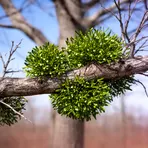
A group of American plants like mistletoe that grow on trees and take water and food from them

A small plant that lives on trees and makes them weaker, often used as a Christmas decoration
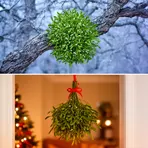
A North American mistletoe that grows on trees that lose leaves and can weaken them, often hung at Christmas
Surface Forms
Morphology
false + mistletoe
The phrase follows the productive adjective+noun pattern where 'false' signals 'not genuine' or 'resembling but not the true kind', so a learner who knows both words can infer it refers to plants that look like but are not true mistletoe. This compositional, cross-linguistically common pattern makes the meaning directly derivable from the constituents for a B1 learner.
Etymology
False mistletoe probably comes from a simple picture: the plant grows in clumps with small berries and so looks like mistletoe, but it is not the real thing, and people used false to show it is 'not the real' mistletoe. So the name means a plant that looks like mistletoe but is actually a different kind.

