

factor XIII
- noun
- /ˈfæktər ˈθɜrˌtiˈnaɪ/
- Specialized
- The activation of factor XIII is a critical step in the final stage of blood coagulation.
Examples
-
When a person lacks factor XIII, their blood clots are weak and prone to breaking down.
-
Doctors may test for factor XIII deficiency in patients with unexplained bleeding.
-
The factor XIII level is crucial for proper blood clotting.
-
Patients with low factor XIII may experience excessive bleeding.
-
Doctors may test for factor XIII deficiency in patients with unexplained bleeding.
-
The activation of factor XIII is a critical step in the final stage of blood coagulation.
-
When a person lacks factor XIII, their blood clots are weak and prone to breaking down.
Synonyms
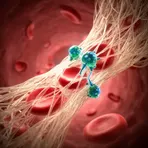
An enzyme that helps make blood clots stronger by joining fibrin threads
Surface Forms
Morphology
The form is partially analyzable: a learner who knows 'factor' and the Roman numeral 'XIII' can infer this refers to 'factor number 13' (a numbered entity). However, the specific biomedical sense — that it is a blood protein that stabilizes clots when activated — is domain-specific and not derivable from the constituents alone, so a B1 learner would not predict the full meaning without prior exposure.
Etymology
Factor XIII gets its name from early blood studies where each important factor was given a number; XIII is the Roman number for 13, so it was the '13th' factor identified. This protein acts like the final stitches that tie a blood clot together, so the name fits its job of making clots strong and stable.

