

to factionalize


 1
8.7
1
8.7
- verb
- /ˈfækʃənəˌlaɪz/
- US
- Historian Laurence M. Hauptmann says the Oneidas were deeply factionalized and suffering an economic crisis in 1933.
- factionalize the movement
- become factionalized
Examples
-
For instance, one said, "Outsider points of view can often be valuable, especially if the insiders are factionalized."
Academic text (1996) -
The DPP, too, gave some appearance of being factionalized.
Academic text (1992) -
What I am sensing is that this incident may be factionalized at school.
Blog text (34) -
Second, the regime continued to factionalize to the advantage of soft-liners, especially pragmatists.
Academic text (2014) -
This leaves ample room for centrifugal ideological differences that tend to factionalize movements.
Academic text (2001) -
A key problem is the degree to which Iranian politics have become factionalized, paralyzing economic policymaking.
Academic text (2004) -
These differences created centrifugal pressures toward internecine conflict that factionalized the movement into disparate groups.
Academic text (2001) -
Until 1980, the EPLF and the increasingly factionalized ELF fought an intermittent but bloody civil war.
Academic text (1990) -
Second, both the Sunnis and the Shiites are highly factionalized, at the national political level and at the level of neighborhood militias and gangs.
Academic text (2007) -
The recent disagreements among the committee members could factionalize the organization into rival groups.
Synonyms
 23
7.2
23
7.2
Make people or groups divide into two opposing sides
 11
6.2
11
6.2
To leave a group and form a smaller, separate one often after disagreement
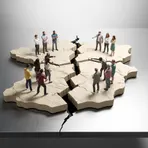 2
9.9
2
9.9
Divide a country or group into smaller, often hostile, parts
 1
7.0
1
7.0
To cause people or groups to separate
 1
7.9
1
7.9
To make a group that was together become divided

Make people split into groups with opposite views and strong disagreement

Make opinions or groups become very divided, often in politics

To break something into many small pieces

To recruit people to become armed fighters in a war
Antonyms


How Divisive
48
4.6

- Literature
23
7.2
- US
1
8.7
11
6.2
513
1.3
680
1.1
Surface Forms
Morphology
Etymology
The word factionalize comes from faction, which means 'a small group' or party, plus the ending -ize, which means 'to make'. So to factionalize is to 'make' smaller groups from a larger one, or to split an organization into smaller, often opposing, groups.