
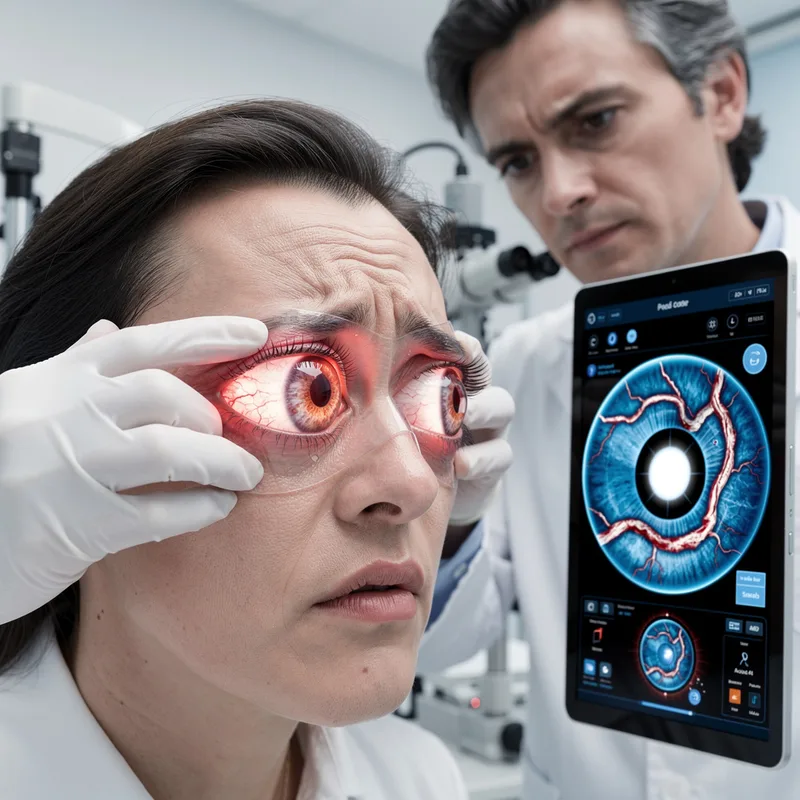
eye disease
 2
3.3
2
3.3

- noun
- /aɪ diːˈziːz/
- Specialized
- Glaucoma is a serious eye disease that can lead to permanent vision loss if not treated.
- vision loss from eye disease
- eye disease glaucoma
- age-related eye disease
Loading YouTube…
Watch on YouTubeHe has an eye disease which leaves him semi blind.
- He has an eye disease which leaves him semi blind.
- Glaucoma is an eye disease where the optic nerve on the back of the eye starts to die very slowly.
- And they told me the way your vision is, you have a eye disease now that it's going to quadruple every three years.
- There have been two age-related eye disease studies called ARIDS, age-related eye disease studies, ARIDS, there was ARIDS and then ARIDS too.
- There is evidence that it can be beneficial for Lieber's congenital eye disease.
- And that's why diabetics get retinopathy, nephropathy, neuropathy, kidney disease, nerve, nerve, nerve damage, and eye disease.
Examples
-
Glaucoma is an eye disease where the optic nerve on the back of the eye starts to die very slowly.
-
Although low vision can be a direct result of aging, it may also result from eye diseases such as macular degeneration, glaucoma, and diabetic retinopathy.
Academic text (2006) -
Knowledge of various eye diseases.
Academic text (2004) -
I mean, I could have a degenerative eye disease or something.
-
However, some ethnicities do have a greater risk for certain eye diseases at younger ages.
Academic text (2006) -
Individuals at risk for eye disease are often older; glaucoma, for example, is especially prevalent in those aged 60 and over.
Academic text (2006) -
Glaucoma is a common eye disease that can cause vision loss and inconvenience to patients.
Blog text (34) -
About 20 years ago, scientists were hard-pressed to find published research studies on correlations between nutrition and the risk of eye disease.
Academic text (2003) -
Glaucoma is a very common eye disease; it is the main cause of ocular hypertension.
Blog text (34) -
NEHEP partners work together to reach identified target audiences, informing them of the importance of early detection and treatment of eye diseases and conditions, particularly glaucoma, diabetic eye disease, and low vision.
Academic text (2006)
Synonyms
 1
3.4
1
3.4
A problem with the eye that affects vision
 1
4.1
1
4.1
A condition where a person can see poorly or not at all

A problem with the eyes that makes it hard to see clearly

A problem in the eyes that makes it hard to see

A problem with your sight that makes things look unclear
How Severe

Surface Forms
Morphology
The meaning 'any disease affecting the eye' is directly and compositionally derived from 'eye' (the organ) + 'disease' (a medical condition); the first noun specifies the locus of the disease. This noun–noun compounding pattern is common in English and in many other languages, so a B1 learner who knows both constituents will readily understand the phrase.
Etymology
Eye disease is a simple compound of eye + disease. It paints the image of an eye that is sick, so the phrase means any illness that affects the eye and can harm sight.