
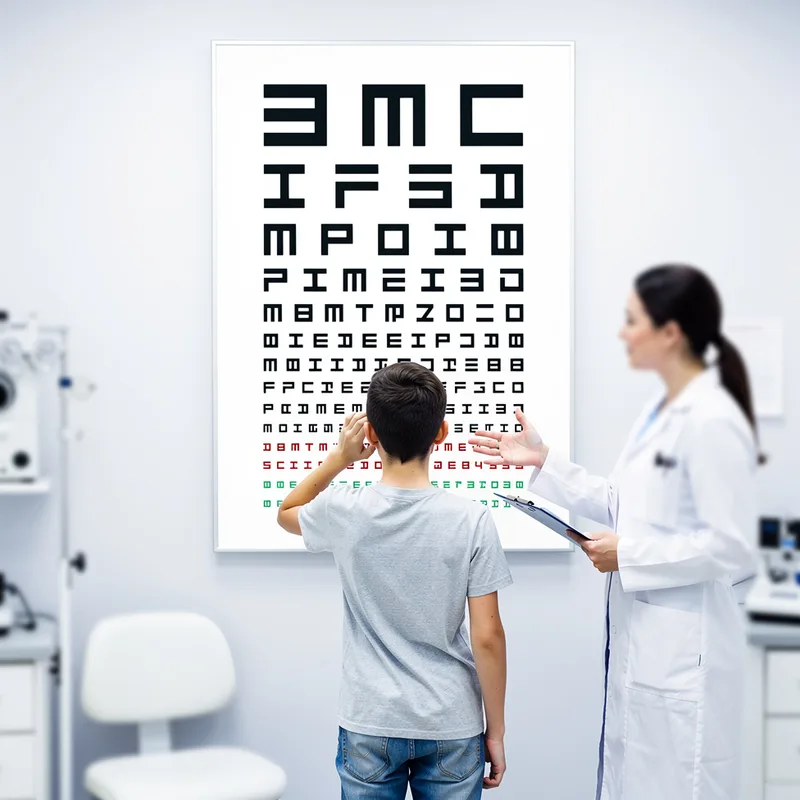
eye chart
 2
3.4
2
3.4

- noun
- /aɪ tʃɑrt/
- Specialized
 :
tabla de visión
:
tabla de visión
- All right, let's look at the eye chart, shall we?
- Snellen eye chart
- the eye chart was used
A simple example, most people have used the Snelling eye chart to see your vision.
- A simple example, most people have used the Snelling eye chart to see your vision.
Examples
-
A person is considered legally blind if he or she has a visual acuity of 20/200 or less (using the Snellen eye chart measurement) in the better eye with best correction or has a visual field of 20 degrees or less.
Academic text (1997) -
You just focus on the eye chart And tell me which option makes the letters clearer.
-
Some traditional vision screening programs within the school system focus on distance vision, using the Snellen eye chart.
Academic text (2012) -
When George Snellen created his familiar eye chart in the middle of the nineteenth century, he chose twenty feet as the base unit for no better reason than it was the length of the typical classroom of his day.
Academic text (1996) -
The doctor asked me to read the letters on the eye chart to check my vision.
-
During the eye exam, I stood in front of the eye chart and started reading the smallest letters.
-
In my optometrist's office, I practiced reading the eye chart to improve my sight.
Synonyms

A chart with rows of letters that get smaller to test how well you can see
How Sensitive

Surface Forms
Morphology
The meaning is directly derivable from 'eye' (vision organ) + 'chart' (a visual display), i.e. a chart related to the eye used for measuring vision. This noun–noun composition follows a common, cross-linguistic modifier pattern, so a B1 learner who knows both constituents would readily infer the intended meaning.
Etymology
Eye chart is a simple page or board with lines of letters that get smaller and smaller so an eye doctor can check how well you see. The words eye and chart make the picture clear: your eye looks at the chart, so it means a page used to 'measure how well you can see'.