
exclusionary rule
 3
8.6
3
8.6

- noun
- /ɪkˈskluːʒəˌnɛri ruːl/
- Formal
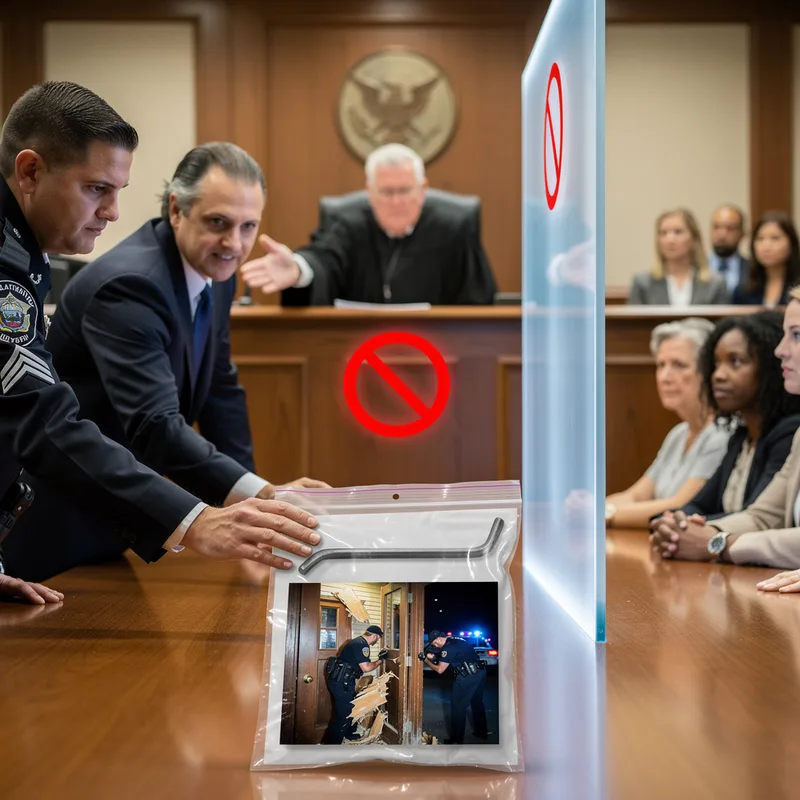
- In criminal trials, the exclusionary rule aims to protect defendants by excluding improperly obtained evidence.
- exception to the exclusionary rule
- exclusionary rule applies
Examples
-
Before the exclusionary rule was introduced in 1914, Fourth Amendment issues arose primarily as affirmative defenses.
Academic text (2018) -
The exclusionary rule has a long history, as well as famous detractors.
Academic text (2009) -
In criminal cases, this idea led to the exclusionary rule, a rule with no basis in the Constitution.
Blog text (17) -
Now the Fourth Amendment exclusionary rule applied, and the Supreme Court took the case to decide how.
Academic text (2018) -
In fact, such concern has long animated the Supreme Court's approach to the exclusionary rule.
Academic text (2018) -
"The exclusionary rule generates substantial social costs, which sometimes include setting the guilty free."
Academic text (2009) -
Much of the criticism leveled at the exclusionary rule is misdirected; it is more properly directed at the Fourth Amendment itself.
Academic text (2017) -
The "judiciary-created" exclusionary rule is "not an individual right," Roberts said, but a means to deter unlawful conduct by the police.
Academic text (2009) -
The Court has also crafted a judicially devised remedy for enforcing Fourth Amendment rights: the exclusionary rule of Mapp v. Ohio.
Academic text (2001) -
The judge explained that the exclusionary rule prevents evidence obtained through unlawful searches from being used in court.
Surface Forms
Morphology
The parts 'exclusionary' (excluding) and 'rule' (regulation) yield a clear general sense — a rule that excludes something — so a learner who knows the words can guess it refers to a rule of exclusion. However, the precise, domain-specific meaning (i.e., barring illegally obtained evidence in criminal trials) is specialized legal knowledge and not directly predictable from the constituents, making the item only partially transparent to a B1 learner.
Etymology
Exclusionary rule comes from the simple idea that exclusionary means 'to keep out' and rule means a law. Imagine a judge refusing to use a piece of evidence the police took without permission, so the rule 'keeps out' illegally obtained evidence, which is why it means a law that stops such evidence from being used in a trial.