
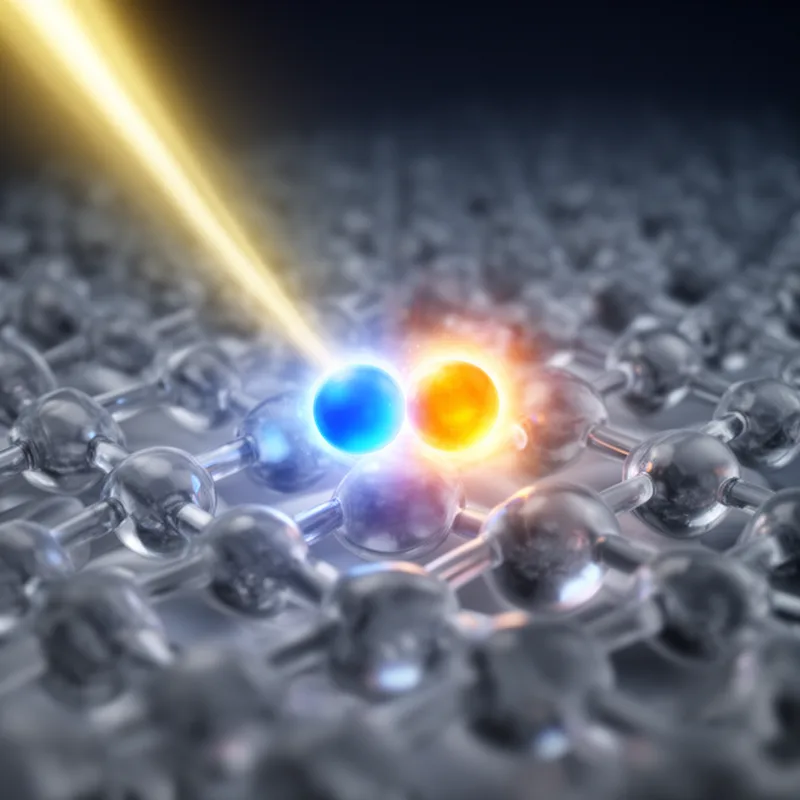
exciton


 1
9.9
- noun
- /ˈɛksaɪtɒn/
- Specialized
- An exciton is formed when an electron binds to a hole after absorbing energy from a photon.
- QD exciton
- exciton substates
- exciton interaction
Examples
-
By using polarized light to orient the exciton spin, the nuclear polarization can be optically pumped to high values.
Academic text (2002) -
When one material absorbs light, you get a an exciton or a bound electron hole pair.
-
Because of the exclusion principle, the third exciton must go into the next excited orbital state.
Academic text (2002) -
A strong laser pulse can create a state of many excitons, each of which has a different energy.
Academic text (2002) -
An example of an entangled state involving excitons is shown in figure 6.
Academic text (2002) -
The excited electron can bind to the hole to form an exciton, which has a hydrogenic wavefunction in the relative coordinate.
Academic text (2012) -
Unfortunately, the experiments have been hindered by the short time the excitons live before the electrons and holes recombine.
Academic text (2004) -
The elementary optical excitation of a quantum dot is the exciton (denoted by X).
Academic text (2002) -
Other researchers are actively pursuing signs of a condensate of excitons that have been photoinduced in more conventional semiconductor systems.
Academic text (2004) -
The biexciton (X2) is formed out of two excitons in the s state and has one doubly degenerate transition.
Academic text (2002)
How Particle-Like

Surface Forms
Morphology
Etymology
Exciton comes from the verb excite, meaning 'to make active or energetic', and the particle ending -on, used in words like electron and meaning 'small particle'. So an exciton is literally an 'excited' particle. It is a pair of an electron and an empty spot called a 'hole' that form when a material absorbs energy.