
excitonic
- adjective
- /ɛkˈsaɪtɒnɪk/
- Specialized
- Excitonic behavior can significantly influence the optical properties of semiconductors.
- excitonic condensate
- excitonic effects
Examples
-
Because the excitonic binding energy is so weak—approximately three orders of magnitude weaker than for a hydrogen atom—excitons exist only at temperatures around 10 K.
Academic text (2012) -
The long-sought evidence for an excitonic condensate has now surfaced in a different and unexpected quarter: a quantum Hall bilayer.
Academic text (2004) -
This type of confinement enhances excitonic effects.
Academic text (1994) -
Experimenters have been searching ever since for excitonic condensates.
Academic text (2004) -
The excitonic ac Stark effect has been extensively investigated both experimentally and theoretically.
Academic text (1994) -
Excitonic binding also plays a major role in the theories of gap excitations of the fractional quantum Hall effect.
Academic text (1994) -
The evidence for excitonic condensates comes from both electron-doped and hole-doped bilayers.
Academic text (2004) -
As this thermalization takes place, the excitonic absorption is strongly reduced because thermalized carriers begin reaching the bottom of the bands.
Academic text (1994) -
Sankar Das Sarma of the University of Maryland, College Park, comments that the recent experiments have demonstrated an excitonic condensate but not necessarily a superfluid.
Academic text (2004) -
This effect has attracted a lot of attention because it can be viewed as a Bose condensation of populations in all the excitonic states stimulated by the "symmetry breaking" pump field.
Academic text (1994)
Surface Forms
Morphology
Etymology
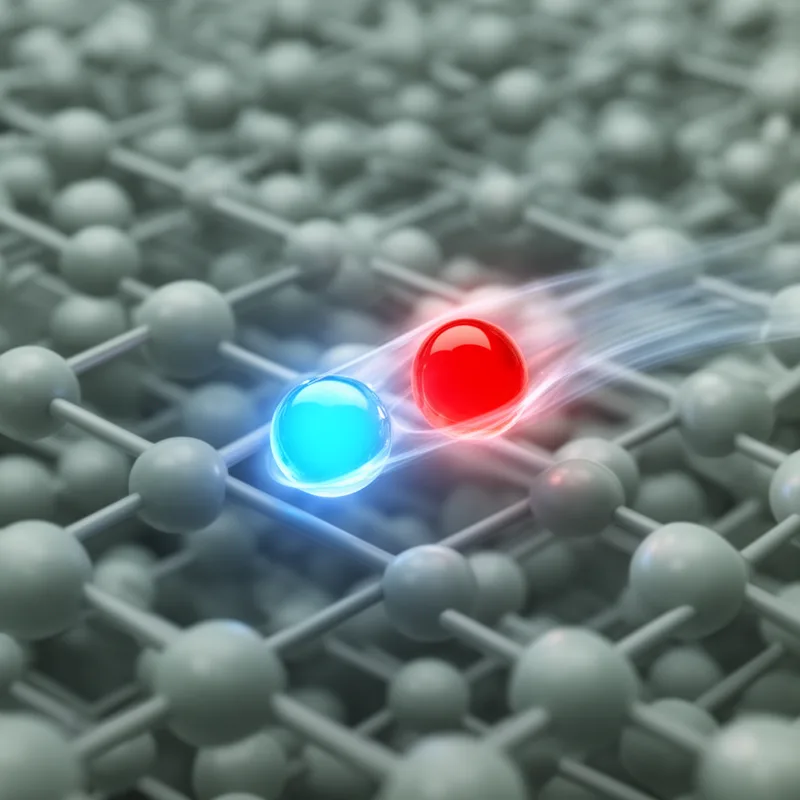
The word excitonic comes from exciton, a name made from excite, meaning 'to make active', and the particle ending -on. So excitonic means 'relating to excitons', the tiny bound pair of an electron and a hole inside a material that can change how the material behaves with light.

