

evening star
 2
3.3
2
3.3

- noun
- /ˈiːv.nɪŋ stɑːr/
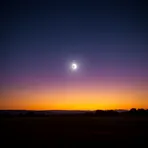
- At sunset, the evening star sparkled brightly in the western sky.
Examples
-
To see first the glory of the sun and then the mild splendor of the moon... and at last the evening star.
-
Venus being the brightest of all the evening stars... and the reigning planet of earthly love.
-
And love is the morning and the evening star.
-
Love is the morning and the evening star.
-
The first evening star has appeared.
Fiction book (1990) -
The evening star was out.
Fiction book (1993) -
But try to imagine a world in which the evening star exists, but the morning star does not.
-
Roshi Joan reminded us that the planet Venus is both the morning and evening star.
Blog text (9) -
It stands as a symbol of strength and survival, its sturdy profile drawn against the twilight and the first evening star.
Academic text (1993) -
The evening star was a gem in the sunset, the air was growing cooler and the breeze fresher, and in the purple twilight the memorial was a dark small hump due west, where the horizon was still streaked orange.
Fiction book (1993)
Synonyms
 58
3.6
58
3.6
The second planet from the Sun that shines brightly at dawn or dusk
 2
9.9
2
9.9
The planet Venus seen in the evening sky after sunset

The planet Venus seen as a bright star in the western sky at sunset
Surface Forms
Morphology
The meaning is directly compositional: 'evening' (the time around sunset) + 'star' (a luminous object) yields an object visible at dusk, so a B1 learner who knows the constituents will infer a bright object seen in the evening (even if they might not know the astronomical detail that it is usually Venus). This naming pattern is cross-linguistically common, making the expression immediately understandable from its parts.
Etymology
Evening star comes from the clear image of a very bright 'star' seen just after sunset. The name links evening, because it appears at dusk, and star, because it looks like a star even though it is usually the planet Venus, and sailors used it to find direction, so today evening star means the bright planet seen in the western sky at sunset.