
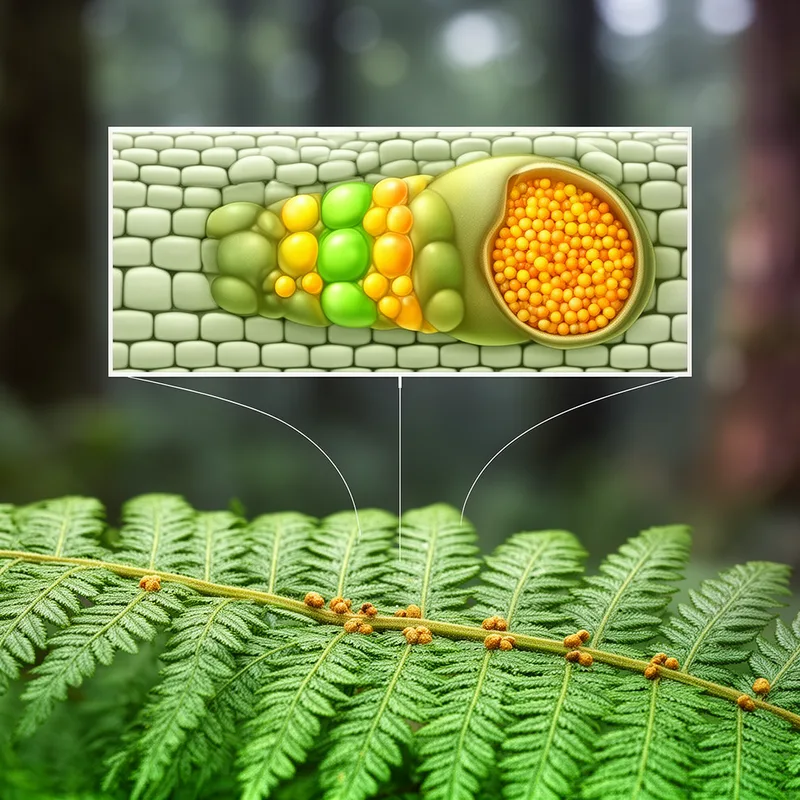
eusporangiate
- adjective
- /juːˈspɔːrənˌdʒiːət/
- Specialized
- Many primitive ferns are classified as eusporangiate due to the structure of their sporangia.
Examples
-
The Ophioglossaceae family consists of eusporangiate ferns with distinctive reproductive features.
-
Researchers studied the development of eusporangiate sporangia in early-diverging fern lineages.
-
The eusporangiate ferns are fascinating to botanists.
-
Are there many eusporangiate species in this region?
-
Many primitive ferns are classified as eusporangiate due to the structure of their sporangia.
-
Researchers studied the development of eusporangiate sporangia in early-diverging fern lineages.
-
The Ophioglossaceae family consists of eusporangiate ferns with distinctive reproductive features.
Antonyms
Surface Forms
Morphology
eusporangiate = eusporangium (opaque) = eu + sporangium + ate
Specialized botanical term; knowing 'sporangium' and the combining form 'eu-' is not sufficient for an average B1 learner to infer the precise technical meaning.
Etymology
Eusporangiate comes from the Greek parts eu- meaning 'good' or 'well' (as in euphoria) and sporangium, a word made from 'spore' and 'vessel' meaning a 'spore container'. So, eusporangiate describes ferns with well-formed spore containers that grow from a group of skin cells rather than from a single cell.

