
eulachon


 1
9.9
- noun
- /ˈjuːləˌkɒn/
- US
- However, the eulachon population is declining, and harvest levels dwindled to less than 5 t per year over the last few years (Bargmann, 1998; PacFIN42).
- eulachon decline
Examples
-
As an addendum, eulachon in the Columbia River deserve mention.
Academic text (2000) -
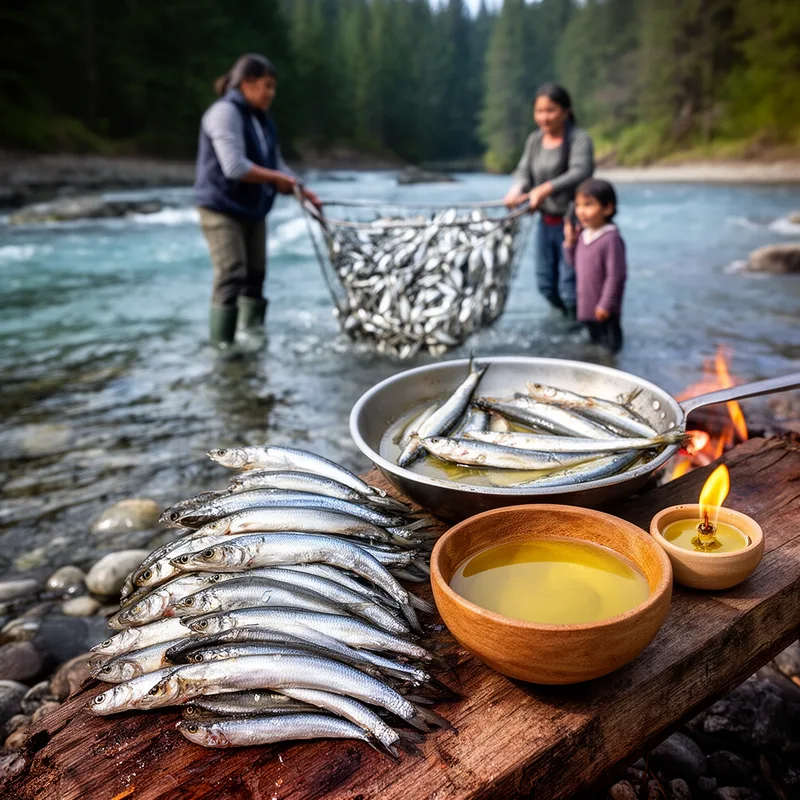
Indigenous peoples have relied on the eulachon as a vital source of food and oil for generations.
-
The patterns and timing of eulachon and salmon runs seem to affect beluga feeding behavior.
Academic text (2000) -
Another common beluga prey species, eulachon, Thaleichthys pacificus, is of uncertain status.
Academic text (2000) -
The importance of eulachon in the winter diet of harbor seals is well documented, but the fishery is not reviewed here because of its small size and localized use of the resource.
Academic text (2000) -
The highest counts of harbor seals in the Columbia River frequently coincide with winter spawning of eulachon (Bargmann, 1998).
Academic text (2000) -
Other species include sculpin, eulachon, capelin, shark, skates, smelt, and octopus. Nonspecified species.
Academic text (2008) -
Eulachon are both commercially and recreationally harvested during the winter spawn, and pinniped consumption was estimated as 26% of the commercial catch (NMFS, 1997a).
Academic text (2000) -
Anecdotal observations indicate declines in numbers in the northern part of the inlet (Kitto(n11)). Eulachon populations in lower Cook Inlet have not been assessed, and no information is available to suggest major changes (Fox(n12)).
Academic text (2000) -
During the spring, the local fishermen gather to catch eulachon, which are prized for their rich, oily flesh.
Surface Forms
Etymology
Eulachon comes from a Pacific Northwest Indigenous word often written as oolichan. It is also called the candlefish because it is very oily and can burn like a 'candle', which is why people valued its oil for food and light.