
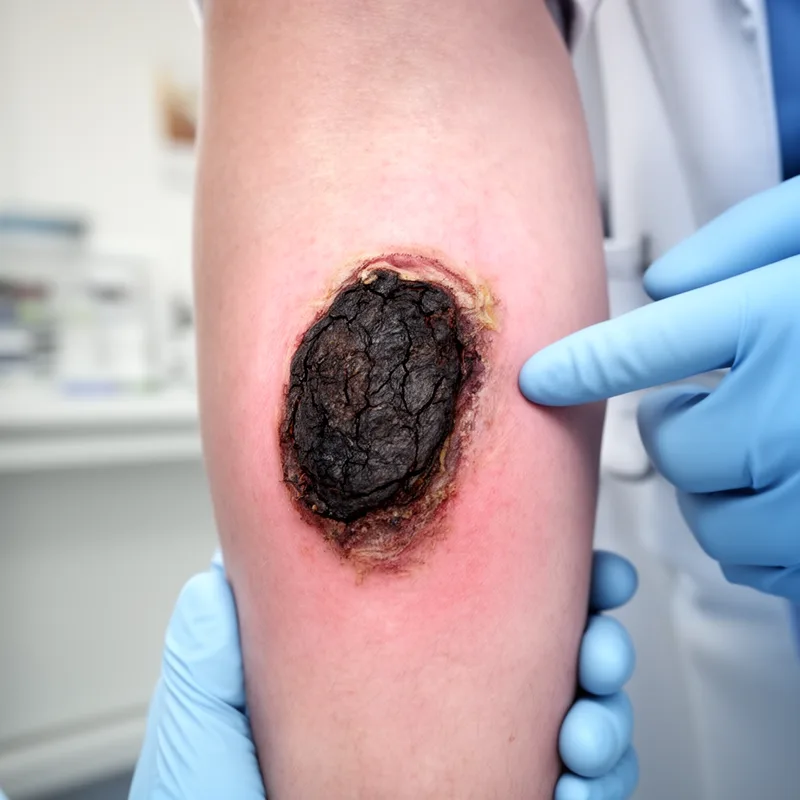
eschar
 1
9.9
1
9.9

- noun
- /ˈɛskɑr/
- Specialized
- Three passes were made, and mechanical debridement of any eschar was performed between passes.
- debridement of eschar
- black eschar
Examples
-
An eschar that formed on the affected skin was left in place as a biologic dressing (Figure 1B).
Academic text (1999) -
If thermal burns cause pressure, relief may be accomplished by debridement of eschar.
Academic text (2004) -
A number of methods will remove eschar and slough from the wound bed.
Academic text (2002) -
We feel that this lack of eschar development may explain the low degree of postoperative bleeding and pain in our patients.
Academic text (2008) -
Instruments that cause more eschar can make it difficult to find the optimal dissection plane.
Academic text (2004) -
After the eschar sloughs off, the amount of remaining tissue may vary.
Academic text (2004) -
Approximately 5 weeks after admission, the eschar had exfoliated, revealing that the underlying skin was pink and healthy.
Academic text (2006) -
Case 1: An eschar formed 1 week following implantation. It was left in place as a biologic dressing.
Academic text (1999) -
Purple eschar was evident along the dorsum, and it extended to the nasal tip.
Academic text (2006) -
The doctor explained that the eschar on the patient's arm was a normal part of the healing process after a burn.
Synonyms

How Severe

Surface Forms
Etymology
Eschar comes from the Greek word eschara, meaning 'fireplace' or 'burnt piece', so picture a dark, dry patch like something burned on a fire. A helpful way to remember it is to think of the English word char ('to burn'), because an eschar is a dry, dead patch of skin often from a burn or infection.