
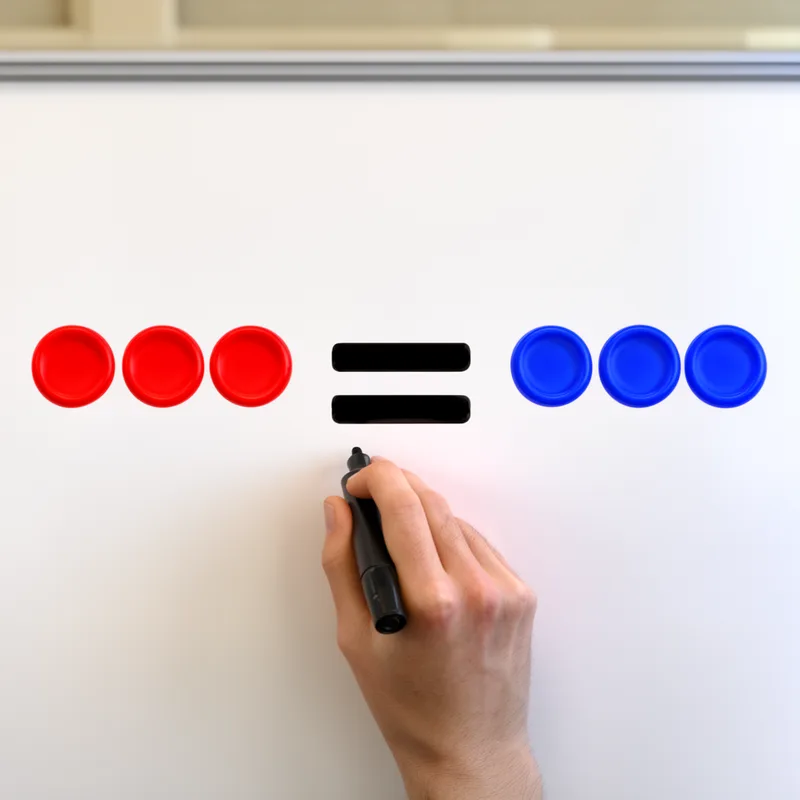
equal sign
 1
1.0
1
1.0

- noun
- /ˈiːkwəl saɪn/
- Specialized
- If they are both an equal sign (==), then it is probably safe to assume that the value is encrypted.
- side of the equal sign
Examples
-
Each problem contained four numbers preceding the equal sign.
Academic text (2005) -
"Now who can make the sticks into an equal sign on the floor?"
Academic text (2001) -
Formulas must always have an equal sign.
Blog text (4) -
So, so I wrote the equations at the top, but really I wasted a lot of time writing in all those plus signs and equal signs and and so on.
-
So the semi equal signs, certain things are connected, but on both worlds there are many models yet where we don't have the specific connection.
-
Now when I describe elimination, it gets to be a pain to keep writing the equal signs and the pluses and so on.
-
I'm going to flip the graph and I'm going to come up this way essentially, and my graph X equals sign of Y is going to look like this.
-
This isn't to say that you shouldn't have TRY/CATCH logic around the code that decrypts the values, as someone could easily enough put two equal signs at the end of their password.
Blog text (27) -
In mathematics, the result of the equation is shown after the equal sign.
-
Make sure to place the correct value after the equal sign to solve the problem.
Surface Forms
Morphology
The meaning 'the symbol "=" used to show that the values on either side are the same' is directly and transparently derived from combining 'equal' (having the same value) with 'sign' (a symbol). This straightforward noun compound follows regular English composition patterns and has clear equivalents across many languages, so a B1 learner who knows both constituents will readily understand it.
Etymology
The noun equal sign comes from a math writer long ago who drew two short lines next to each other to show two things were the same. The word equal means 'the same' and sign means 'a mark', so the equal sign became the mark that shows two sides have the same value.