
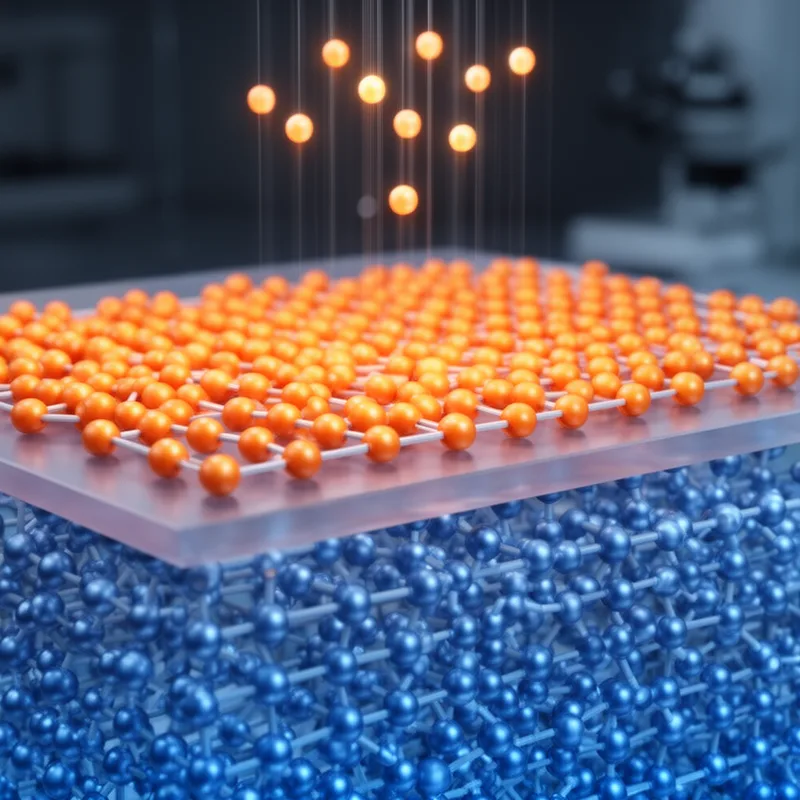
epitaxy


 1
9.9
- noun
- /ˌɛpɪˈtæksi/
- Specialized
- Such islands can be produced by molecular-beam epitaxy and, within the constraints of the underlying lattice geometry, are distributed randomly on the surface in a variety of sizes and shapes.
- beam epitaxy
- molecular-beam epitaxy
- chemical-beam epitaxy
Examples
-
GaAs technology had grown out of early efforts by Esaki and Raphael Tsu to make superlattices and the development of molecular-beam epitaxy.
Academic text (1993) -
One ingenious, highly promising route to tightly confined quantum dots uses patterned substrates combined with multilayer epitaxy to grow very small quantum wires and dots.
Academic text (1994) -
Analytic and vacuum techniques made possible the development of molecular-beam epitaxy, which may yet play a major technological role.
Academic text (1993) -
Transmission electron microscope image of crystalline MgO layers between layers of iron, formed using molecular beam epitaxy by a team at Japan's National Institute of Advanced Industrial Science and Technology in Tsukuba.
Academic text (2004) -
Modifications of the basic molecular-beam epitaxy and chemical vapor deposition techniques have spawned new techniques with names such as atomic-layer epitaxy, migration-enhanced epitaxy, and chemical-beam epitaxy.
Academic text (1993) -
When a multiple heterostructure with two thin GaAs layers is prepared by epitaxial growth techniques such as molecular-beam epitaxy or metal-organic chemical vapor deposition, a double quantum well forms.
Academic text (1994) -
Crystal Solar is trying a similar approach on etching silicon wafers to create pores, then doing epitaxy, depositing a ceramic slurry, and then exfoliating a thin layer; efficiencies are still low, though.
Blog text (23) -
Molecular-beam epitaxy is a widely used method for producing high-quality crystalline layers in semiconductor manufacturing.
-
Researchers developed a new epitaxy technique to improve the efficiency of photovoltaic cells.
-
The process of epitaxy allows for precise control over the thickness and orientation of the crystal layers.
Surface Forms
Morphology
epitaxy = taxis (opaque) = epi + taxy
Formed from specialist combining forms (epi- + -taxy / taxis) used in technical contexts, so learners cannot reliably infer the meaning from the parts.
Etymology
Epitaxy comes from the parts epi- meaning 'upon' and taxis meaning 'order' or 'arrangement', the same root you see in tactic. Think of it like laying a thin sheet 'upon' a patterned floor so the sheet copies the pattern beneath it, which is why epitaxy means a crystal layer grows 'upon' another crystal and keeps the same order.