
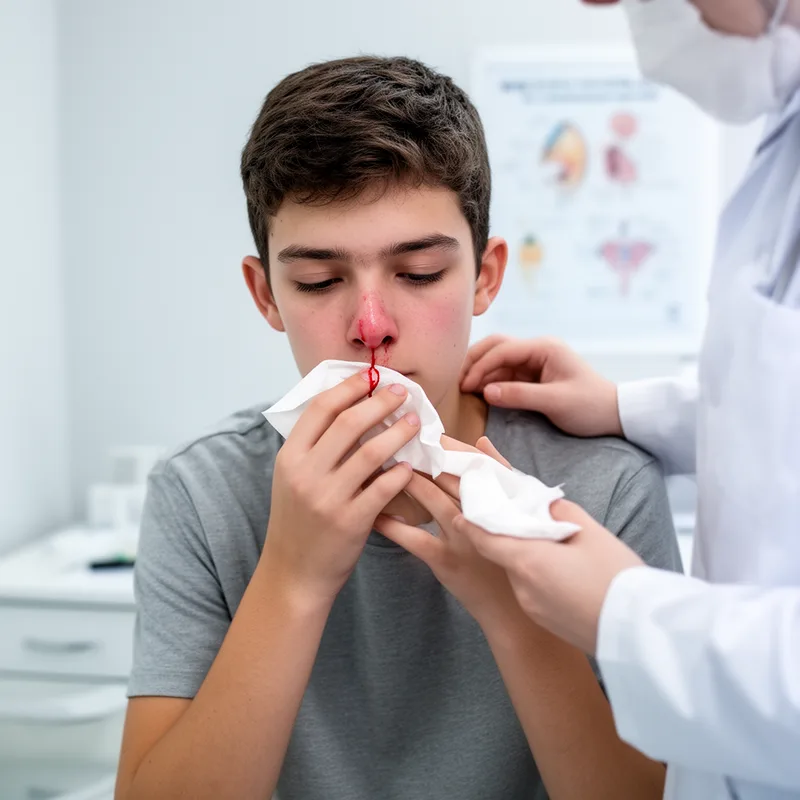
epistaxis
 1
9.9
1
9.9

- noun
- /ˌɛpɪˈstæksɪs/
- Specialized
- When she got a nosebleed, she quickly learned that applying pressure could help stop the epistaxis.
- incidence of epistaxis
- severe epistaxis
- recurrent epistaxis
Examples
-
We evaluated a 44-year-old man who complained of recurrent right-sided epistaxis of approximately 2 years' duration.
Academic text (2008) -
Reports suggest that episodes of epistaxis are usually minor and self-limited.
Academic text (2008) -
All patients were asked whether they had experienced epistaxis within the prior 2 months.
Academic text (2008) -
No complications related to the procedure were observed, and the frequency of epistaxis decreased to about once a week.
Academic text (2003) -
During episodes of epistaxis, patients with coagulopathy may continue to bleed despite conservative measures.
Academic text (2005) -
For many years, he had had daily epistaxis, anosmia, and severe difficulty breathing through his nose.
Academic text (1998) -
Indications for use and frequency of epistaxis were also evaluated.
Academic text (2008) -
Patients usually present with headache, rhinorrhea, or epistaxis along with black nasal or oral masses.
Academic text (2004) -
Most affected patients experience epistaxis or hemoptysis and an enlarging lesion in the nose.
Academic text (2008) -
Although patients with nasal septal perforation may be asymptomatic, many present with intermittent epistaxis, crusting, pain, and rhinorrhea.
Academic text (2006)
Synonyms
 33
2.7
33
2.7
Blood coming from the nose
Surface Forms
Etymology
Epistaxis comes from Greek parts epi- 'upon' and -staxis 'a dripping'. So think of it as 'dripping upon' the nose, which is why epistaxis means a nosebleed.