
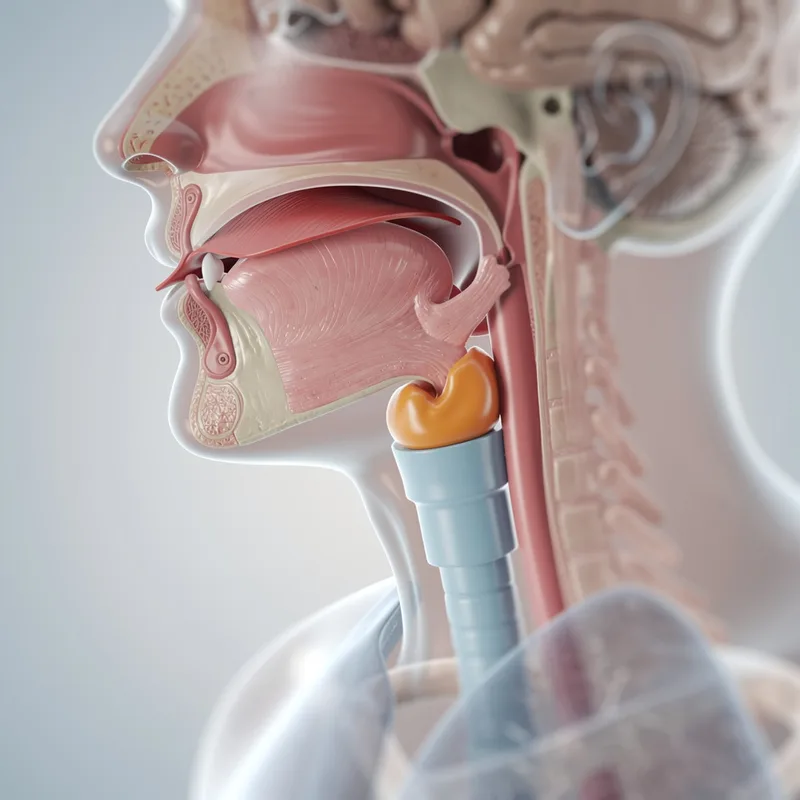
epiglottis
 4
7.7
4
7.7

- noun
- /ˌɛpɪˈɡlɑːtɪs/
- Specialized
- When we eat, a flap of cartilage called the epiglottis prevents food from entering our windpipe.
- surface of the epiglottis
- scarred epiglottis
- cartilage of the epiglottis
Loading YouTube…
Watch on YouTubeA screen of pink, pink pink obliterates the shoehorn edge of epiglottis.
- A screen of pink, pink pink obliterates the shoehorn edge of epiglottis.
Examples
-
As the larynx elevates, the epiglottis is flipped posteriorly and inverts, forcing the bolus around the larynx.
Academic text (2004) -
The swelling was visualized arising from the anterior surface of the epiglottis on the right side.
Academic text (2005) -
Part of the resected epiglottis on the right side is visible.
Academic text (2005) -
The cartilage of the epiglottis lay exposed.
Academic text (2007) -
The tip of the cannula is seen at the tip of the epiglottis.
Academic text (2004) -
Part of the epiglottis on the right side where swelling was present was also resected.
Academic text (2005) -
A small hole was seen below the epiglottis, but the vocal cords could not be visualized.
Academic text (2007) -
Direct laryngoscopy revealed a fungating mass on the laryngeal surface of the epiglottis.
Academic text (1995) -
The epiglottis was found to be scarred and abnormally adhered to its surrounding tissues in both cases.
Academic text (2007) -
The upper aerodigestive passage is significantly narrowed by the retroflex epiglottis, whose edges actually touch the posterior pharyngeal wall (white arrow).
Academic text (2010)
Surface Forms
Morphology
Etymology
Epiglottis comes from the Greek parts epi- meaning 'on' and glottis meaning 'tongue' or 'opening of the windpipe', so it is the little flap 'on the tongue' that folds down to cover the windpipe when you swallow and keeps food out of your lungs.