
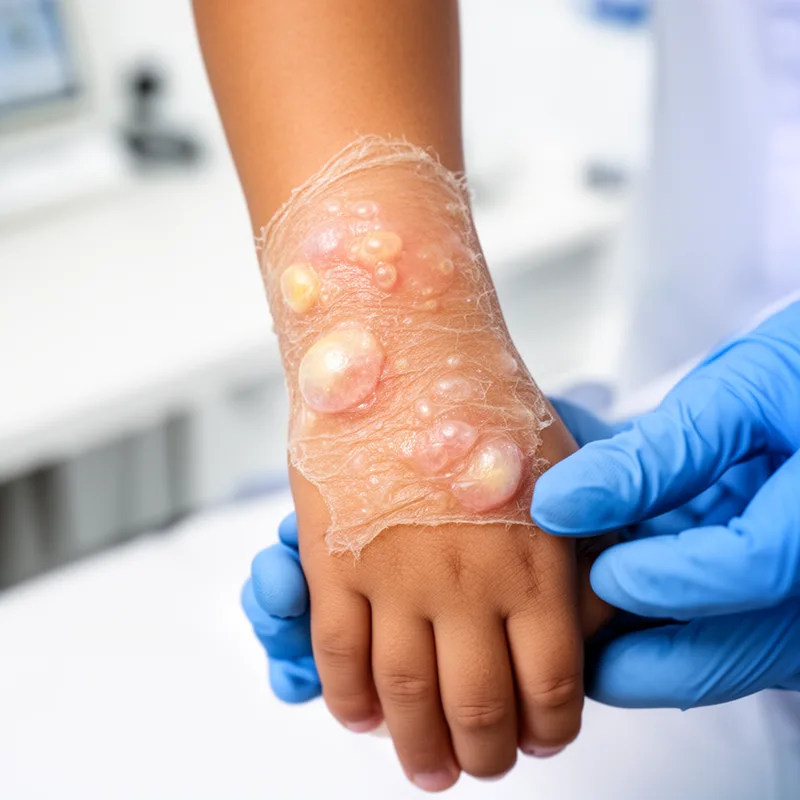
epidermolysis


 1
9.9
1
9.9
- noun
- /ˌɛpɪˈdɜrməˌlaɪsɪs/
- Specialized
- Also, as a carrier of the Epidermolysis Bullosa (EB) illness, Larnee frequently spoke about her disease face-to-face in virtual essays from an online course she was taking and posted her conversations to other blog sites as well.
- epidermolysis bullosa
Examples
-
Epidermolysis Bullosa...
Blog text (22) -
Living with Epidermolysis Bullosa
Blog text (22) -
The patient described in case 1 experienced only epidermolysis of a portion of the operative flap.
Academic text (1999) -
The area of congestion demarcated over the next 3 days to approximately 2 x 3 cm, and then it progressed to epidermolysis.
Academic text (1999) -
Apologies for some late news that you probably already knew about, but last week Eddie made a surprise appearance at a benefit for kids with Epidermolysis Bullosa.
Blog text (5) -
The Epidermolysis Bullosa Medical Research Foundation and the Jackson Gabriel Silver Foundation have committed to contributing up to $450,000, matching gifts from other donors received by December 31, 2012, dollar for dollar.
Blog text (22) -
But little compares with the heartbreak he sees working with children who have epidermolysis bullosa (EB), a fatal disease that can cause the skin to slough off at even the slightest touch.
Blog text (22) -
The patient described in case 1 experienced only epidermolysis of a portion of the operative flap.
-
The area of congestion demarcated over the next 3 days to approximately 2 x 3 cm, and then it progressed to epidermolysis.
-
Epidermolysis bullosa is a rare, incurable disease that causes the skin to blister and break easily.
Synonyms
A rare skin disease that causes large thin blisters on the skin or in the mouth
How Severe
- Specialized
1
9.9

- Specialized
- Specialized
- Specialized
14
4.7
128
2.7
Surface Forms
Morphology
epidermolysis = epidermis (semi-transparent) = epi + derm + lysis
The composition 'epidermis' + '-lysis' is morphologically regular, but '-lysis' is a technical combining form and the whole term is specialized medical vocabulary not transparent to average learners.
Etymology
Epidermolysis is made of Greek parts: epi- 'on', derm 'skin', and -lysis 'loosening' or 'breaking down', like in analysis where you 'break' something into parts. So, the word literally says the outer skin 'loosens' or 'comes apart', which explains why epidermolysis means the top layer of skin becomes loose and can form blisters.