
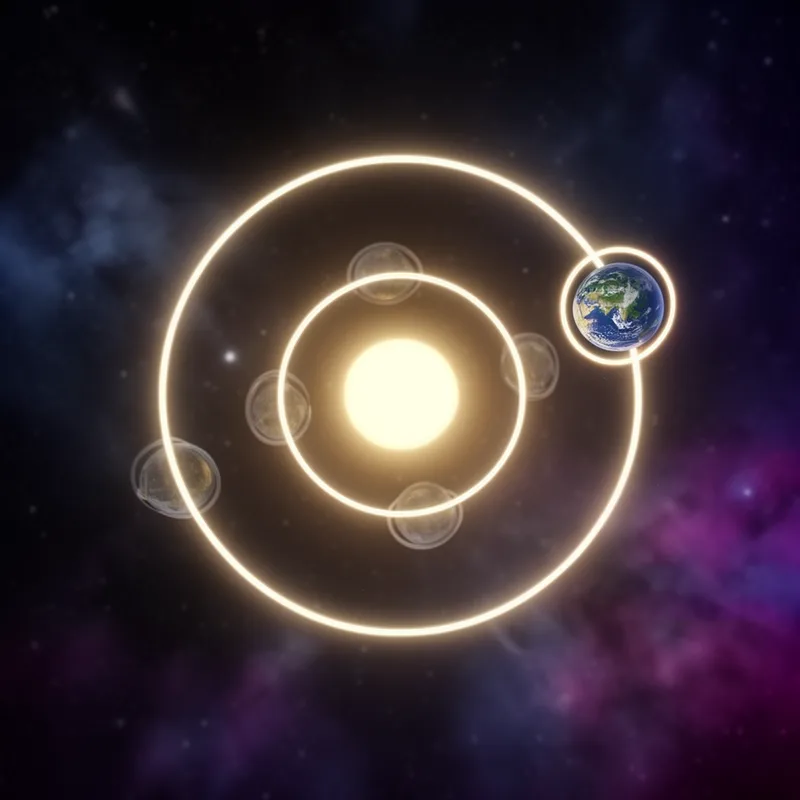
epicycle
 1
9.9
1
9.9

- noun
- /ˈɛpɪˌsaɪkəl/
- Specialized
- To understand retrograde motion, astronomers used the concept of epicycles, where a smaller circle moves along a larger orbit.
- epicycle and deferent
Loading YouTube…
Watch on YouTubeSo you, you keep adding epicycles in order to to cover things that have gone wrong.
- So you, you keep adding epicycles in order to to cover things that have gone wrong.
- Fantasy, folly, bunk science, epicycles, a mirage, unscientific, and on and on it goes.
Examples
-
The model of planetary motion included multiple epicycles to accurately predict celestial positions.
-
Would these theoretical advances occur under an epicycle system?
Blog text (27) -
At one point, astronomy consisted of a series of epicycles; as new information was obtained, a new epicycle was added.
Blog text (15) -
The planets move in elliptical orbits rather than in circles and epicycles.
Academic text (2003) -
In order to account for these confusing departures from observation, Ptolemy introduced the concept of epicycles—smaller spheres on which planets orbited as they simultaneously moved around Earth.
Academic text (2004) -
In ancient astronomy, the planets were thought to move in circular paths called epicycles around the Earth.
Surface Forms
Morphology
Etymology
Epicycle comes from the Greek parts epi- meaning 'on' or 'upon' and kyklos meaning 'circle', the same root as cycle. So an epicycle is literally a small circle 'on' a larger circle, which is why ancient astronomers used it to explain the strange paths of the planets.