
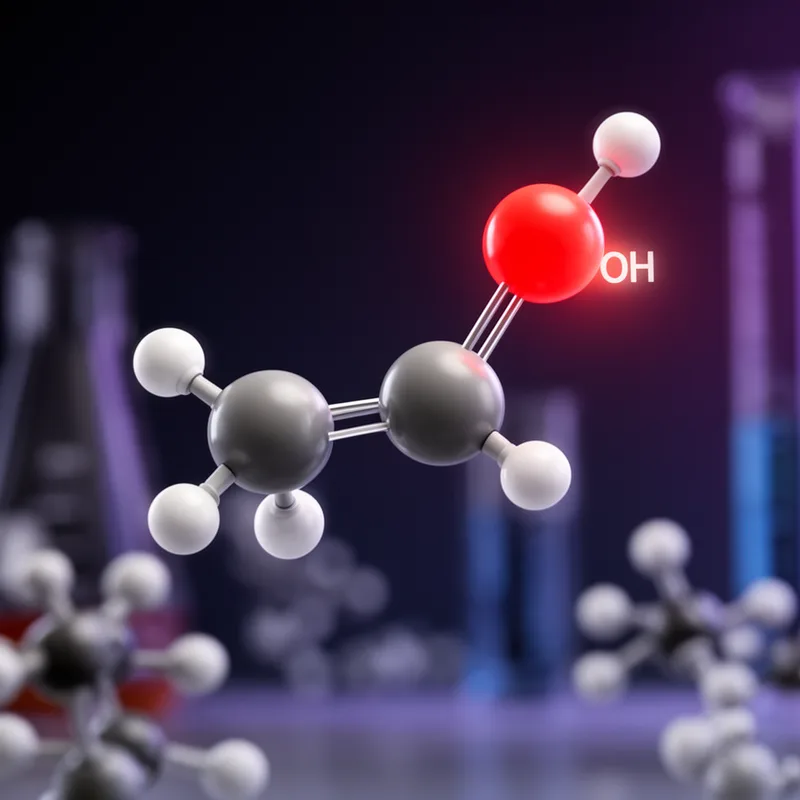
enol


 1
9.9
- noun
- /ˈiːnɒl/
- Specialized
- In organic chemistry, an enol is formed when a hydroxyl group is attached to a carbon atom that is double-bonded to another carbon.
Examples
-
If it just happens by chance to pass when the enol form is present, well, the wrong base gets inserted and that creates a mutation.
-
But that can lose a proton to generate an enol, OK.
-
However, in certain cases the enol can form and get stabilized.
-
And you remember what those things are called enols, right?
-
And just like we talked about for the pyruvate kinase reaction, enols much prefer to rearrange into the.
-
The ketal protecting group is derived from a carefully selected enol ether to which the phenolic hydroxyl is added under acidic conditions (Scheme VI).
Academic text (2001) -
The compound exhibited characteristics typical of an enol, including a hydroxyl group attached to a carbon-carbon double bond.
-
During the experiment, we observed that the enol form of the compound was more reactive than its keto counterpart.
Surface Forms
Morphology
enol = en + ol
The word is built from specialised chemical combining forms ('en-' for a C=C double bond and '-ol' for an alcohol) that are not productive standalone English words, so learners cannot reliably derive the meaning from common vocabulary.
Etymology
The word enol comes from two parts: en- like in alkene, meaning 'double' for a carbon bond, and -ol meaning 'alcohol'. So an enol is an 'alcohol' that sits on a carbon with a 'double' bond, which explains the name.