
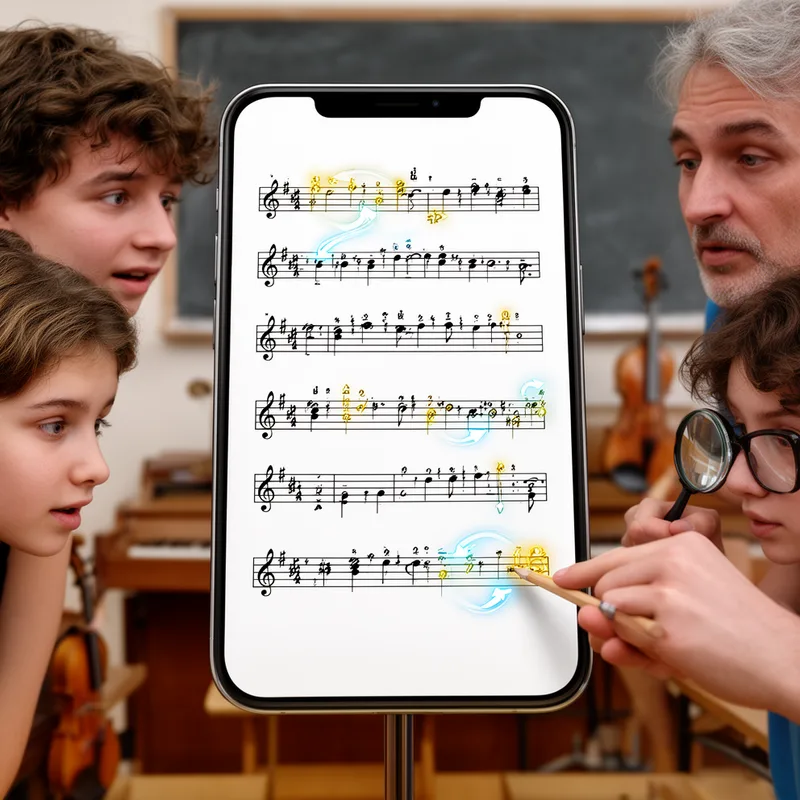
enigma canon
- noun
- /ɪˈnɪɡmə ˈkænən/
- Archaic
- The composer wrote an enigma canon that challenged even the most skilled musicians to decipher its meaning.
Examples
-
Many Renaissance sheet music collections contain at least one enigma canon as a test of wit and skill.
-
Many composers experimented with the enigma canon during the Renaissance.
-
His fascination with puzzles extended to music, where he crafted a remarkable enigma canon for his students.
-
The enigma canon was a fascinating musical puzzle.
-
Many Renaissance sheet music collections contain at least one enigma canon that showcases the creativity of composers.
-
The composer wrote an enigma canon that was famous for its complex and cryptic musical structure.
-
Musicians often study an enigma canon to improve their problem-solving skills in deciphering intricate scores.
Synonyms

A musical piece where each voice starts at a time shown by puzzle signs

A musical piece where the voices follow hidden instructions written as riddles

A musical piece where players solve clues to know when to start playing
Surface Forms
Morphology
The word 'enigma' clearly conveys 'puzzling' so a learner might guess the phrase refers to something cryptic, but 'canon' here is a specialised musical term (a type of imitative composition) rather than the common sense 'rule' shown in the entry. The specific historical/musical meaning (a canon signalled by cryptic symbols) is specialized and not fully derivable from the ordinary senses, so the expression is only partially predictable.
Etymology
The noun enigma canon names an old musical 'puzzle' where the composer gave only hidden signs instead of clear parts, so players had to work out when each voice should enter. The name links enigma meaning 'mystery' and canon meaning 'musical round', so an enigma canon is a piece you must 'solve'.

