
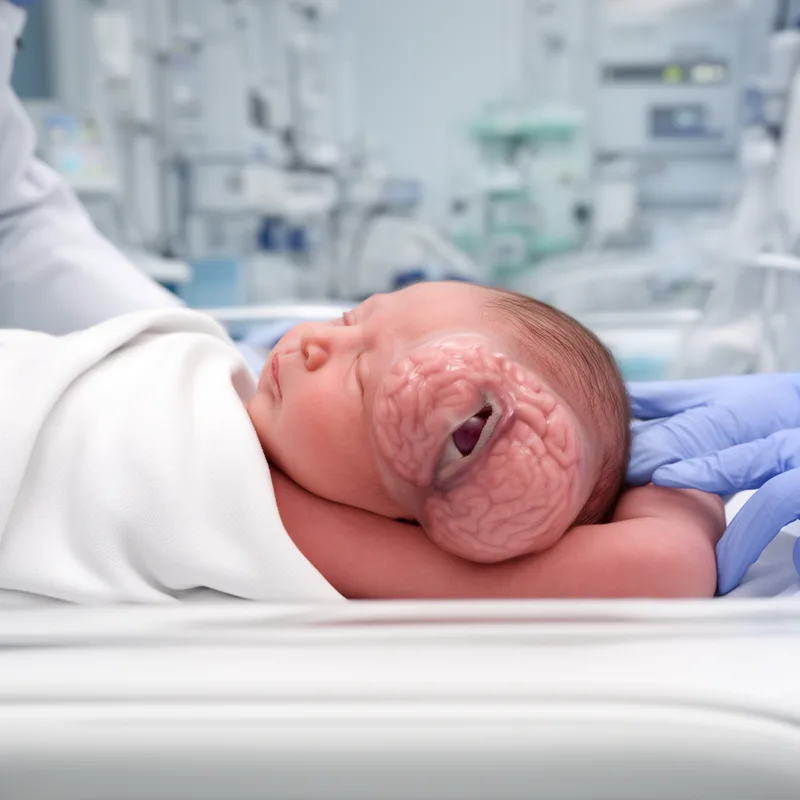
encephalocele


 1
9.9
- noun
- /ˌɛn.səˈfæl.əˌsiːl/
- Specialized
- The surgeon explained that an encephalocele occurs when brain tissue protrudes through an opening in the skull.
- intrasphenoidal encephalocele
- lateral encephalocele
Examples
-
If a significant defect in the tegmen is not reconstructed, an encephalocele (herniation of brain tissue) might occur.
Academic text (2004) -
Only three cases of bilateral lateral-recess intrasphenoidal encephaloceles have been reported in the literature.
Academic text (2004) -
Intrasphenoidal encephalocele is a rare entity.
Academic text (2004) -
The clinical presentation of intrasphenoidal encephalocele varies.
Academic text (2004) -
MRI was able to provide three-dimensional images of the encephalocele that were useful for both diagnosis and surgical planning.
Academic text (2004) -
The development of encephaloceles of the skull base can be congenital, spontaneous, or a result of trauma.
Academic text (2004) -
Most intrasphenoidal encephaloceles are believed to arise in the central aspect of the sinus.
Academic text (2004) -
Lateral intrasphenoidal encephaloceles are rare anomalies.
Academic text (2004) -
Intrasphenoidal encephaloceles extend into the sphenoid sinus and are confined by its floor.
Academic text (2004) -
Over time, the effects of gravity may thin the dura of the encephalocele and lead to CSF leak, meningitis, and seizures.
Academic text (2004)
Synonyms

A birth defect where brain tissue and its coverings push out through the skull
Surface Forms
Morphology
encephalocele = encephalon (opaque) = encephalo + cele
The elements are specialized Greek combining forms ('encephalo-' and '-cele') and the meaning is a technical medical term not inferable by an average B1 learner.
Etymology
Encephalocele comes from Greek parts: encephalo- meaning 'brain' and -cele meaning 'a swelling' or 'hernia'. So it names a condition where part of the brain pushes out through an opening in the skull, which makes it easy to remember as a 'brain hernia'.