

embryonic tissue
 1
5.4
1
5.4

- noun
- /ˌɛm.briˈɑ.nɪk ˈtɪʃ.u/
- Specialized
- Researchers are studying how embryonic tissue can be used in regenerative medicine to repair damaged organs.
Loading YouTube…
Watch on YouTubeSo Virginia is an expert in the extra embryonic tissues, which I know less about.
- So Virginia is an expert in the extra embryonic tissues, which I know less about.
Examples
-
During the early stages of development, embryonic tissue forms the basis for all the organs in the body.
-
I argue that such research, including the development of new cell lines from embryonic tissues from IVF clinics, should be conducted so that the research process will have at least some minimal monitoring.
Academic text (2001) -
In order to attempt this procedure, I'm going to need some embryonic tissue.
-
Clay had been nothing more than a bit of embryonic tissue when his grandmother had taken him in.
Fiction book (1995) -
The blastocyst must be treated with respect appropriate to early human embryonic tissue.
Academic text (2001) -
The majority of the skull bones and the clavicle develop through intramembranous ossification, in which the bones are formed directly from an embryonic tissue known as mesenchyme.
Academic text (2006) -
The doctor explained that embryonic tissue is crucial for understanding how human development begins.
Synonyms
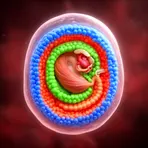
A main group of cells in a young animal before birth that forms body parts
Surface Forms
Morphology
The noun phrase is directly compositional: 'embryonic' (relating to an embryo) modifies 'tissue' (a group of cells), so the meaning 'tissue in an embryo that develops into organs' follows immediately from the parts. This literal, scientific naming pattern is cross-linguistically common and therefore readily inferable by a B1 learner who knows both constituent words.
Etymology
Embryonic tissue paints a simple picture: very early embryonic tissue is a tiny group of cells that act like building blocks for a body. So it means the tissue in an embryo that will 'grow into' organs and other body parts.