
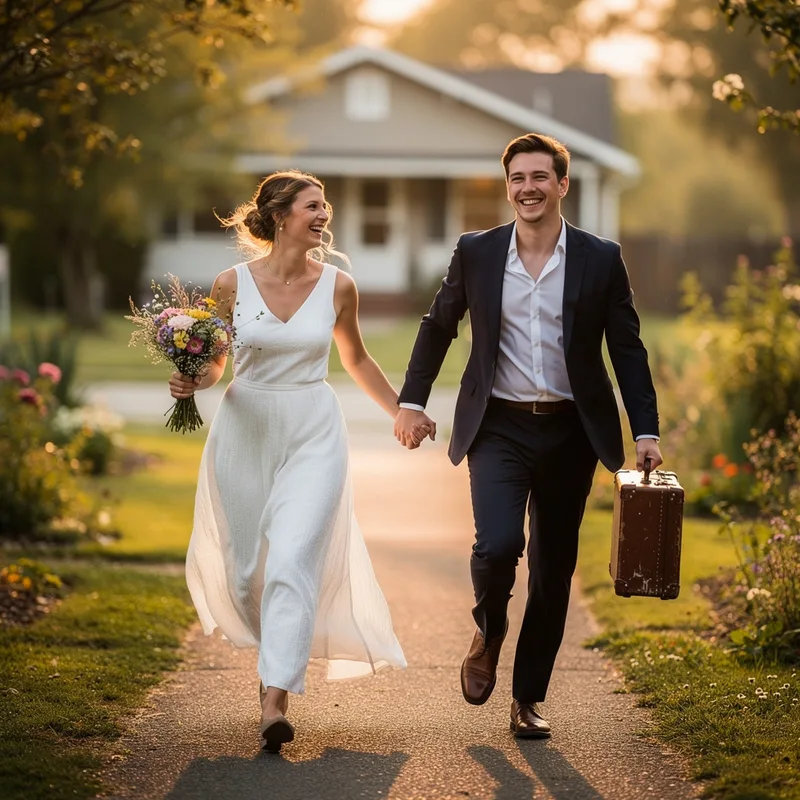
to elope
 48
6.1
48
6.1

- verb
- /ɪˈloʊp/
- Dylan and I have decided to elope to the beach this weekend without telling anyone.
- elope with a lover
Loading YouTube…
Watch on YouTubeWe did joke or not joke about you just eloping in Vegas.
- We did joke or not joke about you just eloping in Vegas.
- And I actually do remember when we were planning, she had mentioned like, well, we could elope.
- The part that means more to me is having a wedding and then we didn't do vows last when we, I call it eloped, I guess you could say.
Examples
-
To escape interference from his mother, Ludwig eloped with Berta and Mrs. Umlauf.
Fiction book (1994) -
I'm not telling you to elope with her.
-
Oh, yeah, Dad would be cool if I went and eloped.
-
I thought you two had eloped.
-
If you and Mark had wanted to elope like Todd and Isabelle, you should have said so earlier.
Fiction book (2000) -
Two days before the wedding ceremony, news reached him that Geetha had eloped with another man.
Academic text (2006) -
The next year, Kath eloped with a boy from high school who was in the Coast Guard in Maine.
Fiction book (1993) -
One weekend, they eloped to Albany and got married in the Cathedral rectory.
Fiction book (1991) -
After months of planning, they finally eloped in a small, secret ceremony in the mountains.
-
She dreamed of the day she could elope with her true love and escape the pressures of family expectations.
Antonyms

Surface Forms
Etymology
The word elope comes from an old English word ælǣpan that meant 'to run away' and is like the modern word lope meaning 'to run with long steps'. So, to elope is to 'run away' to get married secretly, which explains the meaning we use today.