
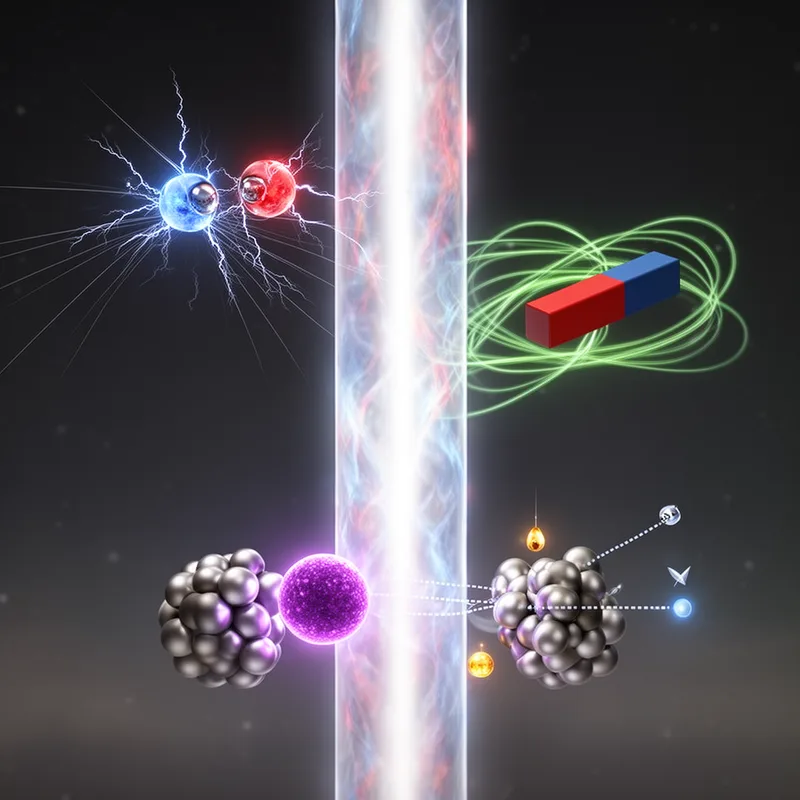
electroweak interaction
- noun
- /ɪˌlɛktrəʊˈwiːk ˌɪntəˈrækʃən/
- Specialized
 :
interacción electrodébil
:
interacción electrodébil
- In particle physics, the electroweak interaction plays a significant role in explaining how particles acquire mass.
Examples
-
In 1961, Glashow published a vector-meson model of electroweak interactions based on what is known now as the SU(2) x U(1) gauge symmetry group.
Academic text (1999) -
With dimensional regularization established, theorists could apply it not only to the electroweak interactions but also to the strong interactions, says 't Hooft. The constraints that were quite clear from our work were so rigid that people knew exactly how to make models, not only that of Weinberg and Salam but also several alternative models.
Academic text (1999) -
The electroweak interaction is responsible for the processes that occur in particle accelerators.
-
Researchers study the electroweak interaction to better understand the fundamental forces that govern the universe.
Surface Forms
Morphology
The noun phrase is compositionally built: 'electroweak' names the unified electromagnetic+weak force and 'interaction' names a process between fields/particles, so the combined meaning is simply an interaction involving the electroweak force. Although technical, the structure is literal and follows normal scientific compounding, so a learner who knows both constituents can infer the meaning.
Etymology
Electroweak interaction is named because it joins two forces: electro (the force behind 'electricity' and light) and weak (the small force that causes some kinds of radioactivity). Scientists found that at very high energy they act as one force, so the name means the single interaction that covers both 'electric' and 'weak' effects.

