
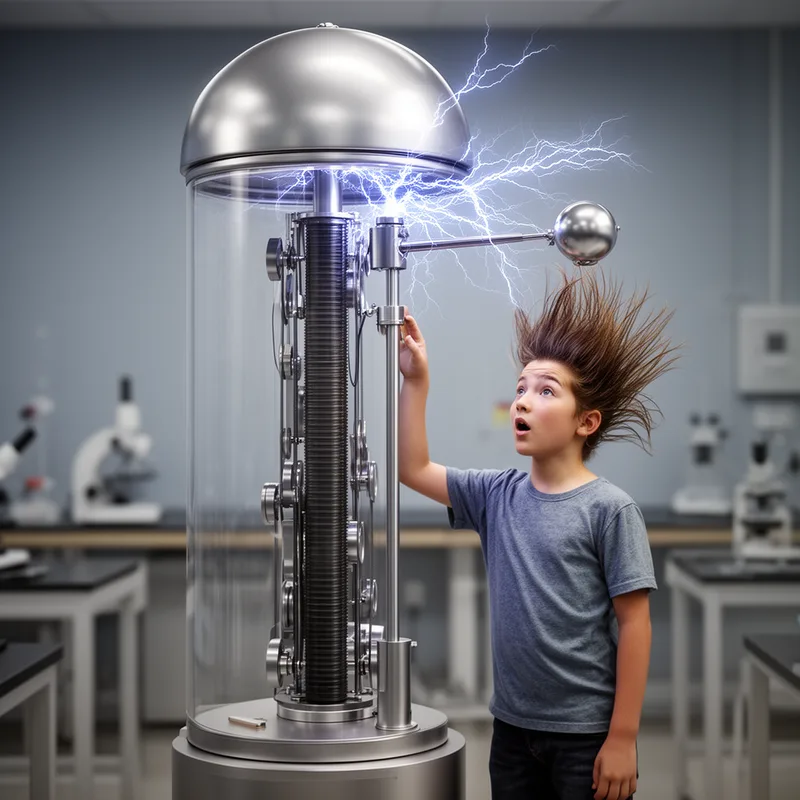
electrostatic machine
- noun
- /ɪˌlɛk.trəʊˈstæt.ɪk məˈʃiːn/
- Specialized
- The electrostatic machine was used in the laboratory to demonstrate the principles of static electricity.
Examples
-
Early scientists built large electrostatic machines to generate powerful sparks and study electrical phenomena.
-
A Van de Graaff generator is a well-known type of electrostatic machine used in physics experiments.
-
The electrostatic machine produced a loud crackling sound.
-
Many scientists use an electrostatic machine for experiments.
-
The scientist used an electrostatic machine to demonstrate the principles of static electricity during the lecture.
-
In the laboratory, an electrostatic machine is essential for experiments involving high voltage generation.
-
Students often gather around the electrostatic machine to see the impressive sparks produced by static electricity.
Synonyms
A machine that makes strong static electricity and can produce sparks
A machine with two rotating disks that makes strong static electricity and visible sparks

A machine that makes strong static electricity so sparks fly and hair stands up

A simple device that makes static electricity using a metal plate and an insulator
Surface Forms
Morphology
The noun phrase is a straightforward adjectival composition: 'electrostatic' (pertaining to static electricity) modifies 'machine' (a device), so the combined meaning 'a device involving static electricity' is directly derivable from the parts. This Adj+N pattern is compositionally transparent and common across languages, so a B1 learner who knows both constituents would readily infer the MWE meaning.
Etymology
Electrostatic machine is named after the old image of rubbing amber to make small shocks and sparks. So a machine that did the same rubbing was called an electrostatic machine, meaning 'a machine that makes static electricity and sparks'.

