
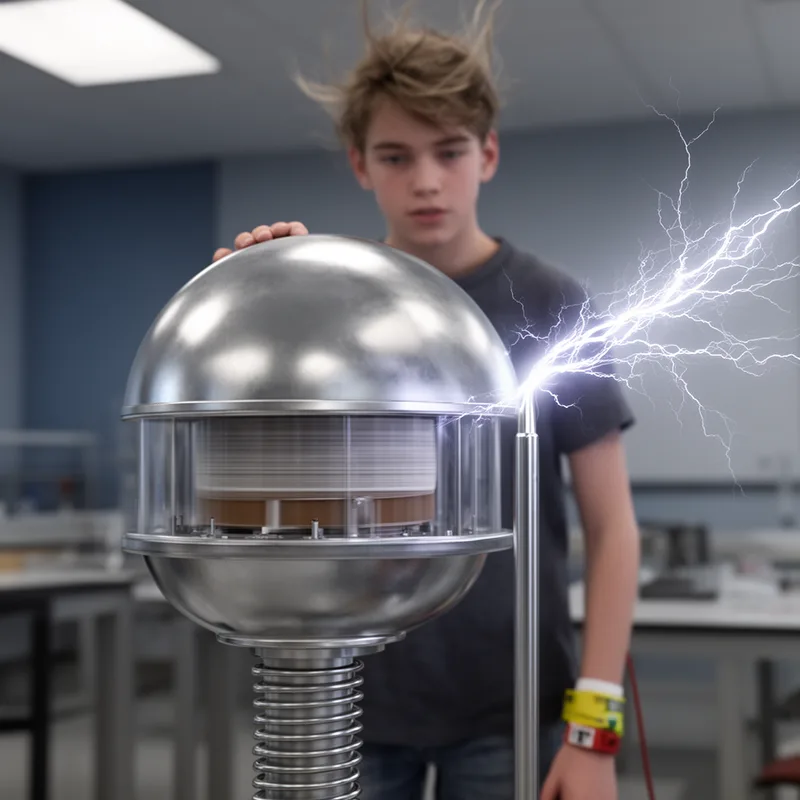
electrostatic generator
- noun
- /ɪˌlɛk.trəʊˈstæt.ɪk ˈdʒɛn.ə.reɪ.tər/
- Specialized
- At the physics lab, the electrostatic generator produced enough voltage to create impressive sparks between its terminals.
Examples
-
The scientist used an electrostatic generator to demonstrate the principles of high voltage and static electricity to the students.
-
A little later (volume 53, 1938), the journal published papers by Raymond Herb and others describing the pressurized electrostatic generators Herb built, which were so important in nuclear physics research in the 1940s.
Academic text (1993) -
He explained how an electrostatic generator works by accumulating electric charge until it reaches a very high voltage.
Synonyms

 3
6.9
3
6.9

A device that makes very strong, quickly changing electric voltages and sparks

A machine that makes a strong electric charge by collecting static electricity
A machine with two rotating disks that makes strong static electricity and visible sparks

A machine that makes strong static electricity so sparks fly and hair stands up

A simple device that makes static electricity using a metal plate and an insulator
A device that makes very high electric voltages to speed charged particles for physics experiments
Surface Forms
Morphology
This is a straightforward adjective+noun composition: 'electrostatic' (pertaining to static electricity) modifies 'generator' (a device that generates electricity), so a B1 learner who knows both constituents can infer it is a device that produces static electric charge or high voltage. The compositional pattern is common and follows regular English modification, making the meaning directly derivable from the parts.
Etymology
Electrostatic generator comes from the idea of electrostatic, that is 'static electricity', and generator, a machine 'to make' power. So the name means a machine that collects static charge and 'makes' very strong electricity for experiments.