
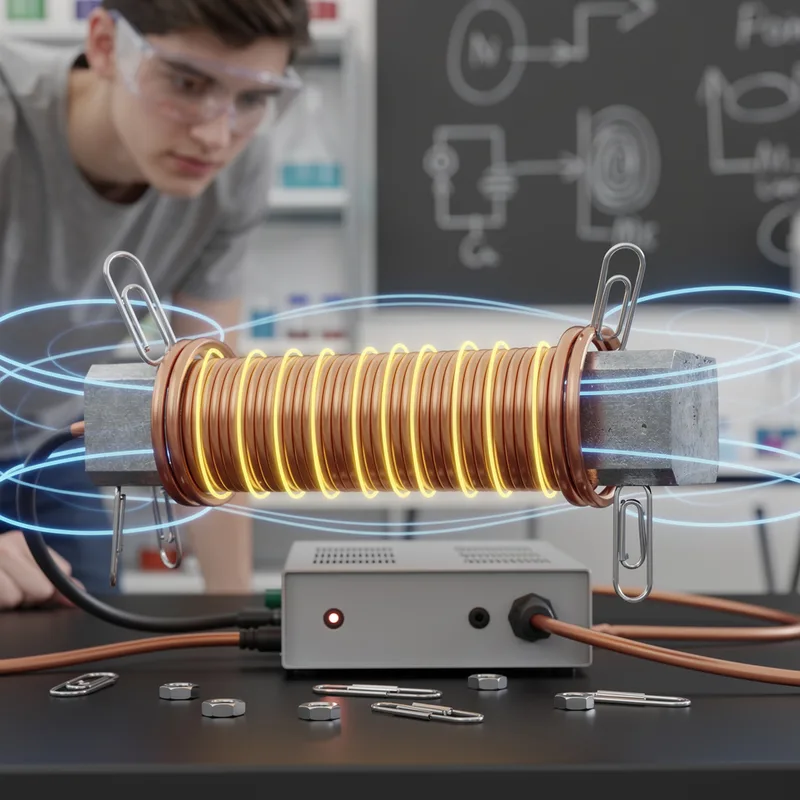
electromagnetism
 6
6.4
6
6.4

- noun
- /ˌɛlɛkˌtroʊˈmæɡnɪˌtɪzəm/
- Specialized
- Chabay and Sherwood have clearly chosen a "less is more" approach to teaching electromagnetism.
- electromagnetism course
- electromagnetism interaction
- theories about electromagnetism
Loading YouTube…
Watch on YouTubeAnd that's, my friends, is today's lesson on electromagnetism.
- And that's, my friends, is today's lesson on electromagnetism.
- The corrections to electromagnetism, they're mostly the ones that we see are mostly coming from quantum effects.
- Well, they react at the speed of electromagnetism between atoms.
- So as we all know, electromagnetism is radiation, therefore it's bad.
- All right, Maybe that's all we have to do to think about gravity with electromagnetism.
- But this was a discovery, you know, again, that our paradigmatic force theory that we thought we understood was electromagnetism going back to Maxwell.
- The pariah of heat and electromagnetism is regulated by the Arduino according to the progression of the atmospheric pressure.
Examples
-
The activity guides divide the two-semester course into four modules: mechanics I, mechanics II, thermal physics, and electromagnetism.
Academic text (1996) -
In the theory of classical electromagnetism, free space has the following properties:
Blog text (29) -
When electrical current flows through a conductor, it produces electromagnetism.
Academic text (2008) -
According to Maxwell's laws of electromagnetism, an electric charge moving in a magnetic field gives rise to electromagnetic radiation.
Academic text (1996) -
In Electric and Magnetic Interactions, Chabay and Sherwood have redefined the content and format of the introductory electromagnetism course.
Academic text (1996) -
The study of electromagnetism explains how electric fields can create magnetic fields and vice versa.
-
Many modern devices, such as electric motors and generators, rely on the principles of electromagnetism.
-
Electromagnetism is essential for understanding how electricity and magnetism interact in various technologies.
Synonyms


 1
7.4
1
7.4
A branch of physics that studies electric and magnetic fields and how they interact

A force between charged particles carried by particles of light
Surface Forms
Morphology
electromagnetism = electromagnet (semi-transparent) = electro + magnet + ism
The word is transparently built from 'electromagnet' plus '-ism', but the resulting sense is a specialized field of study rather than a simple literal combination.
Etymology
The word electromagnetism starts with electro- (from electron, a Greek word for 'amber', because rubbing amber can make a small electric charge) and adds magnet (a rock that 'pulls' iron), so it literally links electricity and magnets. So, electromagnetism is the force that explains how electricity and magnets work together.